Carnivorous Plant Farms Bat Poop Instead of Eating
TL;DR: Snowshoe hares change coat color based on day length, not snow. As climate change shortens snow seasons, white hares stand out against brown landscapes, increasing predation by 7% per week. Some populations carry a borrowed gene for staying brown, offering a potential genetic lifeline.
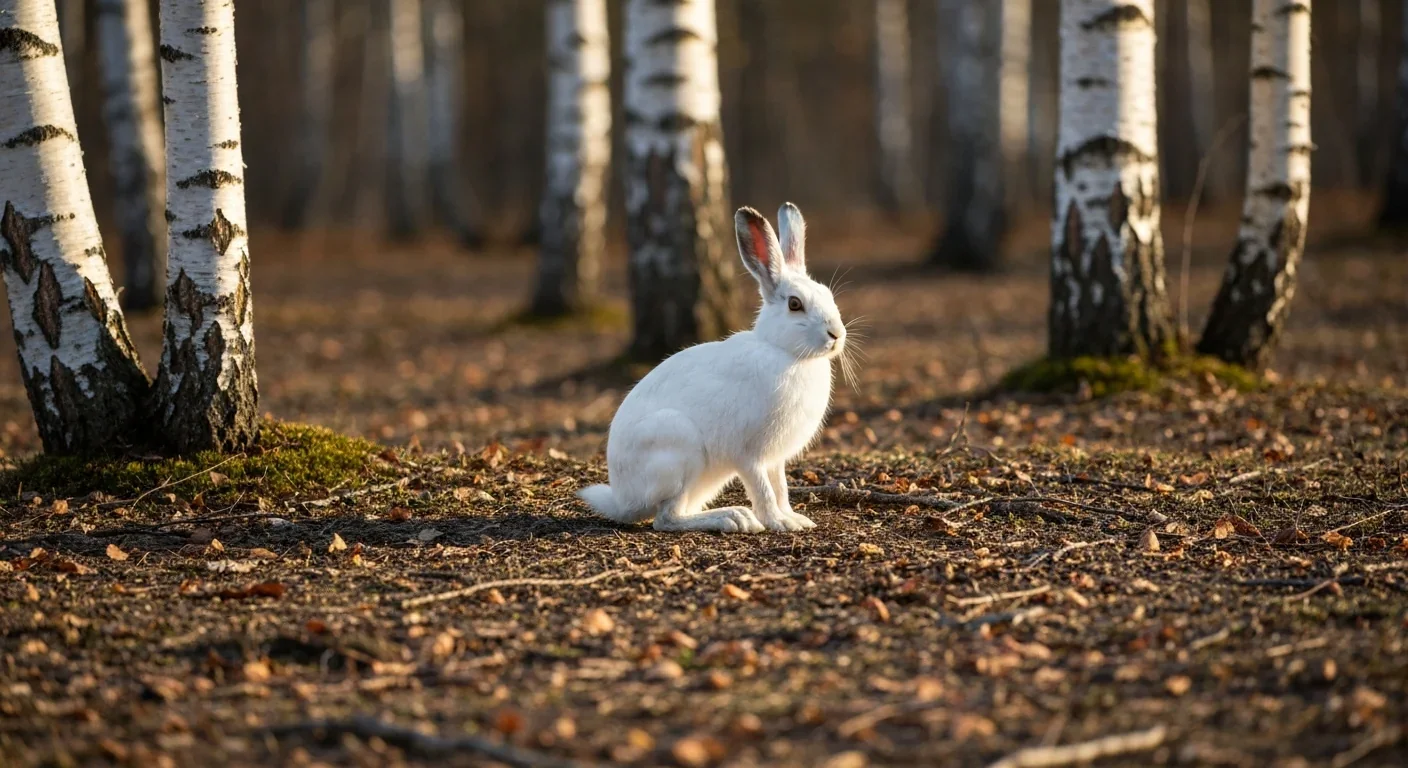
Imagine an animal so perfectly tuned to its environment that it changes its entire coat twice a year, like a living mood ring for the seasons. Now imagine that same animal stuck in a biological time warp, wearing the wrong outfit while predators close in. That's the reality facing snowshoe hares across North America right now, and the reason they can't fix it is both fascinating and deeply troubling. Their camouflage clock runs on sunlight, not snow, and climate change is breaking the connection between the two.
Snowshoe hares pull off one of the most dramatic wardrobe changes in the animal kingdom. Twice a year, they swap between a rich brown summer coat and a pristine white winter one. But here's what most people get wrong about this transformation: it has absolutely nothing to do with temperature or snowfall.
The trigger is photoperiod, the changing length of daylight hours. As autumn days grow shorter, photoreceptors in the hare's retina detect the dwindling light and relay signals to the pineal gland, a tiny structure deep in the brain. The pineal gland responds by ramping up production of melatonin, the same hormone that makes you sleepy at night. In hares, though, elevated melatonin does something far more dramatic. It kicks off a hormonal cascade that flows through the hypothalamus and pituitary gland, releasing thyroid hormones that ultimately reach individual hair follicles across the animal's body.
At the follicle level, melatonin suppresses the production of eumelanin, the pigment responsible for brown and black coloration. Meanwhile, the agouti signaling protein competes with alpha-melanocyte-stimulating hormone for binding to the MC1R receptor on melanocytes. When ASIP wins that molecular tug-of-war, pigment production shuts down entirely, producing hair shafts that are not just white but structurally different: hollow, air-filled tubes that provide superior insulation compared to their pigmented summer counterparts.
The whole process takes roughly 10 weeks to complete, starting at the extremities, ears and feet, and working inward across the body. By the time the first heavy snows blanket the boreal forest, the hare is fully white. Come spring, lengthening days reverse the cascade, and brown fur grows back in. It's a beautifully precise system, one that has kept snowshoe hares alive for millennia.

The snowshoe hare's molt isn't triggered by cold or snow. It's driven entirely by day length, processed through a melatonin-based hormonal cascade that hasn't changed in thousands of years, even as winters have.
This system seems oddly indirect. Why not just respond to temperature or snow itself? The answer reveals something profound about how natural selection actually operates on deep timescales.
Over thousands of years, day length was the single most reliable predictor of seasonal conditions in northern ecosystems. Temperature fluctuates wildly from day to day and year to year. An October warm spell doesn't mean winter isn't coming. Snow can arrive early one year and late the next. But the photoperiod on any given calendar date at any given latitude is identical every single year. It never varies, never lies, never arrives late.
Natural selection favored hares that used this rock-solid astronomical signal because they consistently got the timing right. A hare that waited for actual snow to start turning white would be exposed during those critical early-snow days. A hare that relied on temperature might molt too early during a cold snap, then face brown ground for weeks. Photoperiod gave them the edge: a dependable countdown clock calibrated to millennia of predictable, snowy winters.
This worked beautifully for thousands of years. The 10-year population cycle of snowshoe hares, which drives the famous boom-and-bust rhythm of Canada lynx populations across 5 million square kilometers of boreal forest, depended on this reliable camouflage. Hare numbers would swell and crash in predictable waves, and lynx populations would follow roughly two years behind, a pattern so reliable that the Hudson's Bay Company tracked it in fur trade records going back to the 1800s.

But then the climate started shifting faster than evolution could keep up, and the elegant logic of this system turned into a trap.
Snow in North America now arrives later in autumn and melts earlier in spring. Research from the University of Alberta shows that maximum winter snow depth in Kluane, Yukon, has decreased by a third over the past two decades alone. Meanwhile, November 15th still has exactly as many daylight hours as it did a century ago.
The hares keep molting on schedule, following their ancient photoperiod cues, but the snow doesn't cooperate anymore. The result is camouflage mismatch: bright white hares sitting on dark brown ground, or brown hares against early snow, visible to every predator with functioning eyes.
The consequences are measurable and severe. Research led by Scott Mills found that each week of camouflage mismatch increases a hare's mortality risk by approximately 7%. That might sound modest, but the mismatch window is growing. What used to be a few days of imperfect camouflage during spring and fall transitions has stretched to weeks in many areas.
"If the hares are consistently molting at the same time, year after year, and the snowfall comes later and melts earlier, there's going to be more and more times when hares are mismatched."
- Alex Kumar, Wildlife Researcher
As Kumar explained, the problem compounds over time. Radio telemetry data confirmed that spring and fall, the transitional seasons when mismatch peaks, are now the deadliest times of year for snowshoe hares. Scott Mills called the sight of a white hare on brown ground "a picture that paints a thousand words, a very clear connection to a single climate change stressor."
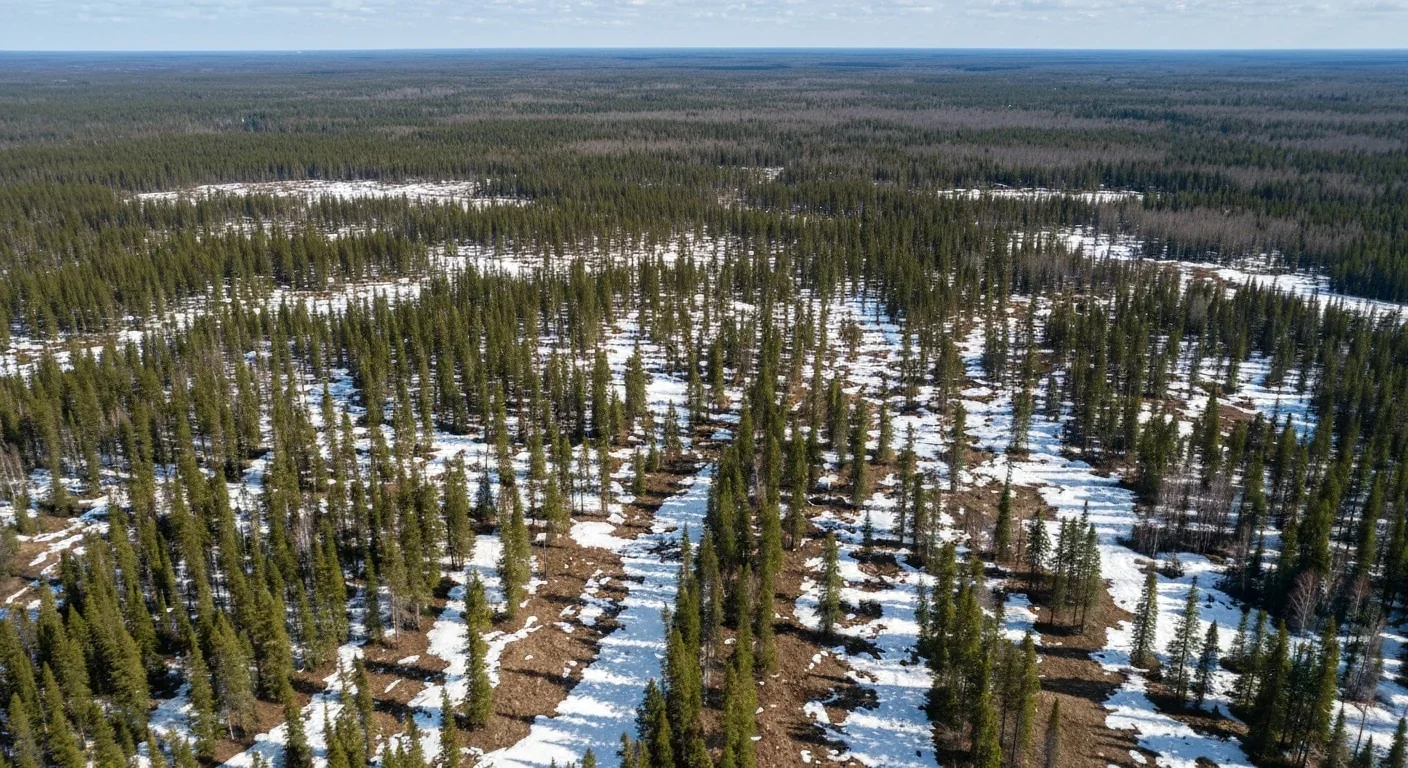
In Michigan, the damage is already quantifiable. A Michigan State University study found that the hare population in the Lower Peninsula has declined by nearly 50%, prompting the Michigan Department of Natural Resources to form conservation partnerships specifically targeting hare habitat protection.
Not all snowshoe hare populations are equally trapped by this ancient clock. In Washington State's Olympic Mountains, some snowshoe hares never turn white at all. In the Cascades, others stay a mottled brown and white year-round. Scientists have found similar brown-winter individuals in West Virginia, Pennsylvania, and southern Maine.
This variation isn't random. A 2018 study published in Science by Jeffrey Good's team at the University of Montana discovered something remarkable: the difference between brown and white winter coats comes down to genetic variation at a single pigmentation gene on chromosome 4, the Agouti gene. Hares that stay brown in winter carry two recessive alleles. Hares that turn white have at least one dominant allele.
Even more surprising, the brown variant wasn't some ancient holdover from a warmer era. It was recently acquired through hybridization with black-tailed jackrabbits. As Matthew Jones, a co-author on the study, explained: "The brown version of the gene in snowshoe hares was recently acquired from interbreeding with black-tailed jackrabbits." Nature, it turns out, has a way of sharing genetic solutions across species boundaries.
The gene that lets some snowshoe hares stay brown in winter wasn't their own invention. It was borrowed from black-tailed jackrabbits through ancient hybridization, a form of evolutionary gene-sharing called adaptive introgression.
This is adaptive introgression at work: one species borrowing a genetic tool from another through interbreeding, then natural selection amplifying it because it provides a survival advantage. Right now, brown winter coats are rare across the snowshoe hare's range. But if snow cover keeps declining, these alleles could spread rapidly through populations under intense selective pressure.
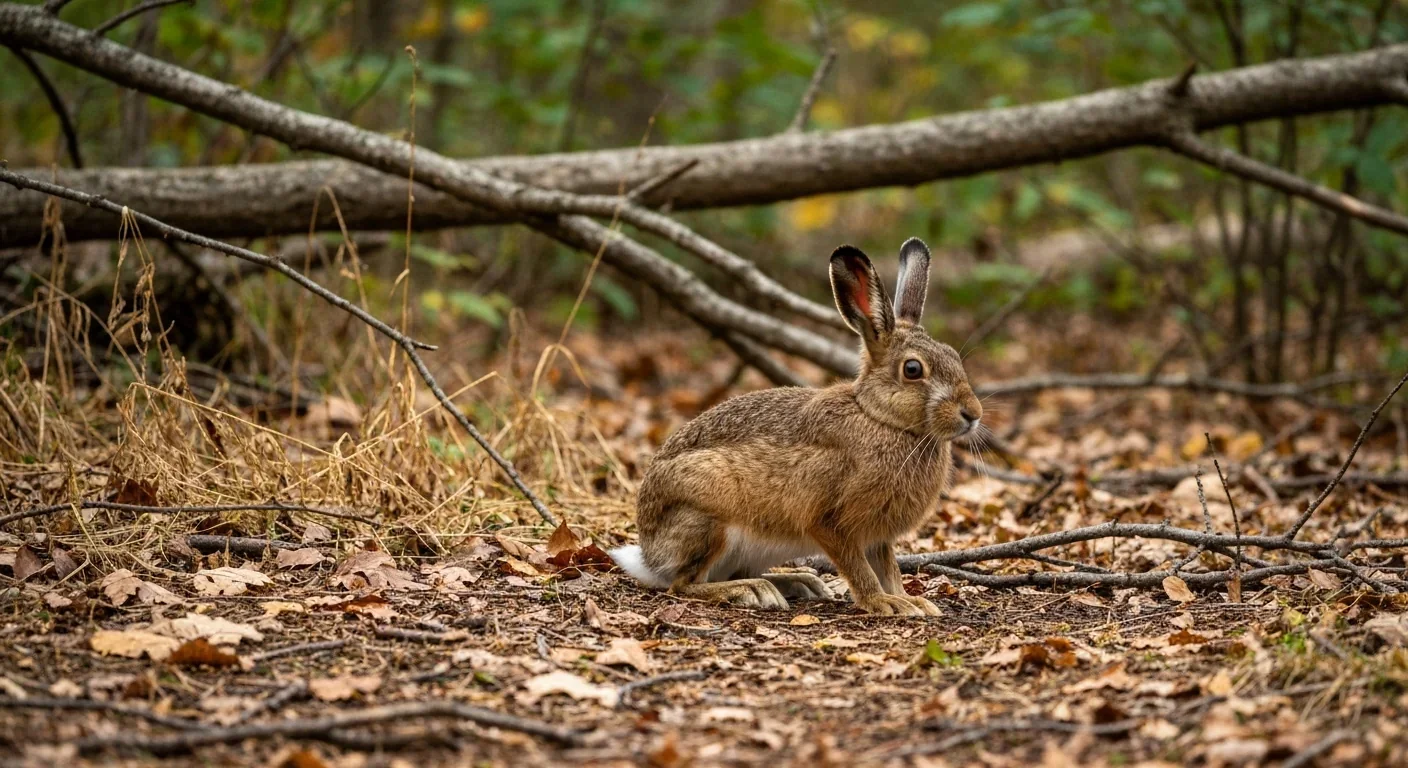
Pennsylvania's brown-winter hares also show other physiological adaptations. Compared to their Yukon counterparts, their underfur is 58% less dense, their guard hairs are 32% less dense and 20% shorter, and they rely heavily on dense vegetative cover, choosing resting spots with greater than 80% visual cover, rather than snow for concealment. They've essentially developed an entirely different survival strategy.
Snowshoe hares aren't just any prey species. They're a keystone herbivore that shapes boreal ecosystems through browsing, influencing plant succession and forest structure. Predation accounts for 80 to 100% of hare mortality in some regions. The Canada lynx depends so heavily on hares that lynx populations track hare numbers in a famous 9-to-11-year cycle, one of ecology's most iconic predator-prey relationships, one that scientists have modeled with Lotka-Volterra equations since the early twentieth century.
Long-term demographic studies based on over 20,000 captures of more than 7,000 individual hares in the Kluane Lake region between 1977 and 2020 have shown that population growth during increase phases is driven primarily by reproductive success and pre-weaning survival. If mismatch-driven predation removes adults during the critical spring and fall breeding seasons, it could dampen these growth phases and flatten the cycle entirely.
A weakened hare cycle doesn't just hurt lynx. Great horned owls, coyotes, foxes, fishers, and American martens all depend on snowshoe hares as a primary food source. When hare populations drop, the cascading effects ripple across entire boreal food webs, affecting dozens of species across millions of square kilometers.
"It's a picture that paints a thousand words, a very clear connection to a single climate change stressor."
- Scott Mills, University of Montana
Snowshoe hares aren't the only animals facing this kind of evolutionary mismatch. Arctic foxes, ermines, least weasels, and several species of ptarmigan all undergo photoperiod-driven seasonal color changes. The underlying physiology is remarkably conserved across mammals: melatonin secretion from the pineal gland, modulated by day length, triggers the hormonal cascades that control pigmentation in species separated by millions of years of evolution.
What makes the snowshoe hare case particularly alarming is the combination of extreme predation dependence, keystone ecological status, and geographic scale. The hare's range spans from Alaska to the Appalachian Mountains, covering almost every boreal and montane forest on the continent. Across that entire range, the photoperiod signal remains fixed while snow patterns shift beneath it.
The tools for helping snowshoe hares are surprisingly practical. Tony D'Amato, a forestry researcher working in Vermont's Nulhegan Basin, has demonstrated that modifying forest canopy structure can meaningfully increase how long snow stays on the ground. His experimental plots showed up to a foot more snow accumulation compared to surrounding areas, with slower melt rates extending the effective snow season. By protecting old-growth forests and creating early-successional openings with overhead shade, land managers can help snow persist longer in critical hare habitat.
More ambitiously, Alexej Siren has received a grant to study whether introducing brown-winter hares from regions like Pennsylvania into New England populations could accelerate the spread of the protective brown allele. This assisted migration approach carries real risks, including potentially depleting brown-gene populations at source locations, but it represents one of the few interventions that addresses the genetic root of the mismatch problem.
Ultimately, the snowshoe hare's predicament illustrates a principle that extends far beyond any single species. When organisms depend on environmental cues that have been reliable for millennia, and those cues suddenly decouple from the conditions they once predicted, even the most elegant adaptations become liabilities. The hare's photoperiod clock isn't broken. The world it was built for is just changing faster than evolution can follow. And whether these animals can bridge that gap, through borrowed genes, managed forests, or sheer evolutionary luck, will tell us something important about how resilient the natural world really is in the face of rapid change.

Project Orion was a real 1960s program to reach other stars by detonating 800 nuclear bombs behind a spacecraft. The physics worked and the engineering was feasible, but the 1963 nuclear test ban treaty killed it. It remains the most credible interstellar spacecraft ever designed.

The locus coeruleus, a tiny brainstem structure, degenerates decades before Alzheimer's symptoms appear. Its loss cripples the brain's inflammation control, waste clearance, and sleep regulation. New imaging tools and noradrenergic therapies offer hope for early detection and prevention.

Research shows the sharing economy often increases total resource consumption through the Jevons paradox and rebound effects. Ride-sharing adds billions of vehicle miles, co-working spaces use more energy per worker, and diffused responsibility erodes conservation behavior. Breaking the paradox requires congestion pricing, accountability design, and matching sharing models to appropriate resource types.

Psychological reactance theory explains why banning or restricting things makes people want them more. From Prohibition to the Streisand effect to scarcity marketing, research shows that threatening people's freedom reliably backfires, and autonomy-supportive communication is far more effective.
A carnivorous pitcher plant in Borneo evolved to house bats instead of trapping insects, gaining up to 95% of its nitrogen from bat guano. The plant even built an ultrasonic reflector to help bats find it, revealing that carnivory in plants is a flexible spectrum.

The quantified self movement began as a hacker-ethos pursuit of personal insight, but corporate wearables now funnel biometric data to employers, insurers, and data brokers. With 81% of Americans wrongly believing health apps are HIPAA-protected, a regulatory void enables health data to be sold for pennies while generating anxiety instead of empowerment.

CXL memory pooling lets servers dynamically share DRAM over a cache-coherent interconnect, eliminating the 40% stranded memory waste in data centers. With commercial hardware now shipping and Azure deploying CXL cloud instances, this technology promises to cut memory costs by 50% while enabling composable infrastructure.

Loading featured articles...