Carnivorous Plant Farms Bat Poop Instead of Eating
TL;DR: Honeybee swarms make life-or-death nest-site decisions through a leaderless democratic process using waggle dances, quorum sensing, and cross-inhibitory stop signals. This system, studied for decades by Cornell biologist Thomas Seeley, almost always selects the best option and has inspired algorithms used in computing and telecommunications.
The future of democracy might not be decided in a parliament, a boardroom, or a Silicon Valley lab. It might already be solved, and it's been solved for tens of millions of years, by an insect with a brain the size of a sesame seed. When a honeybee colony outgrows its hive, thousands of bees face a collective decision that will determine whether they live or die. And they make that decision without a leader, without a vote, and without a single bee understanding the full picture. The result? They almost always pick the best available option. It's a system so sophisticated that one Cornell biologist calls it "a striking example of decision making by an animal group that is complicated enough to rival the dealings of any department committee."
That biologist is Thomas D. Seeley, the Horace White Professor Emeritus in Biology at Cornell University, who has spent over four decades studying how honeybee colonies function as collective decision-making units. His landmark 2010 book, Honeybee Democracy, synthesized decades of field experiments into a single astonishing conclusion: a honey bee colony works as a single decision-making unit to choose its nesting site. Not through individual genius. Not through hierarchical command. Through a decentralized, competitive, self-correcting process that looks remarkably like the best version of democracy humans have ever imagined, and in some ways surpasses it.
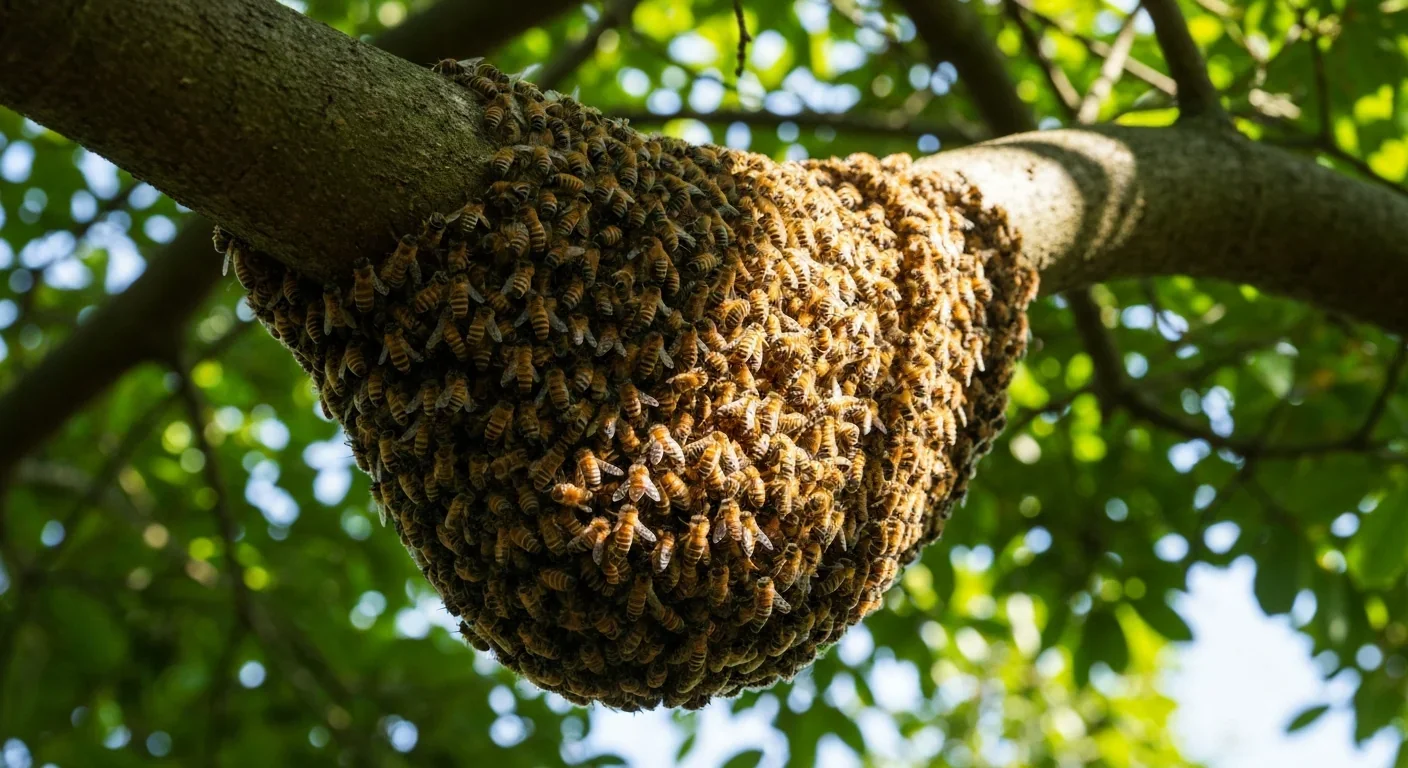
Every spring and summer, when a colony becomes too large for its hive, it divides in a process called swarming. The old queen departs with roughly 40 to 70 percent of the worker bees, typically 10,000 to 20,000 individuals. They gorge themselves on honey before leaving, carrying their only fuel supply. Then they cluster on a tree branch or an overhang, forming a living, buzzing mass the size of a football.
This is where the clock starts. The swarm can only survive for about three days on its stored honey. There is no resupply. There is no backup plan. If the swarm doesn't find a suitable new home, the colony's genetic lineage, carried by that departing queen, dies.
And yet, during this ticking-clock crisis, the swarm doesn't panic. It deliberates.
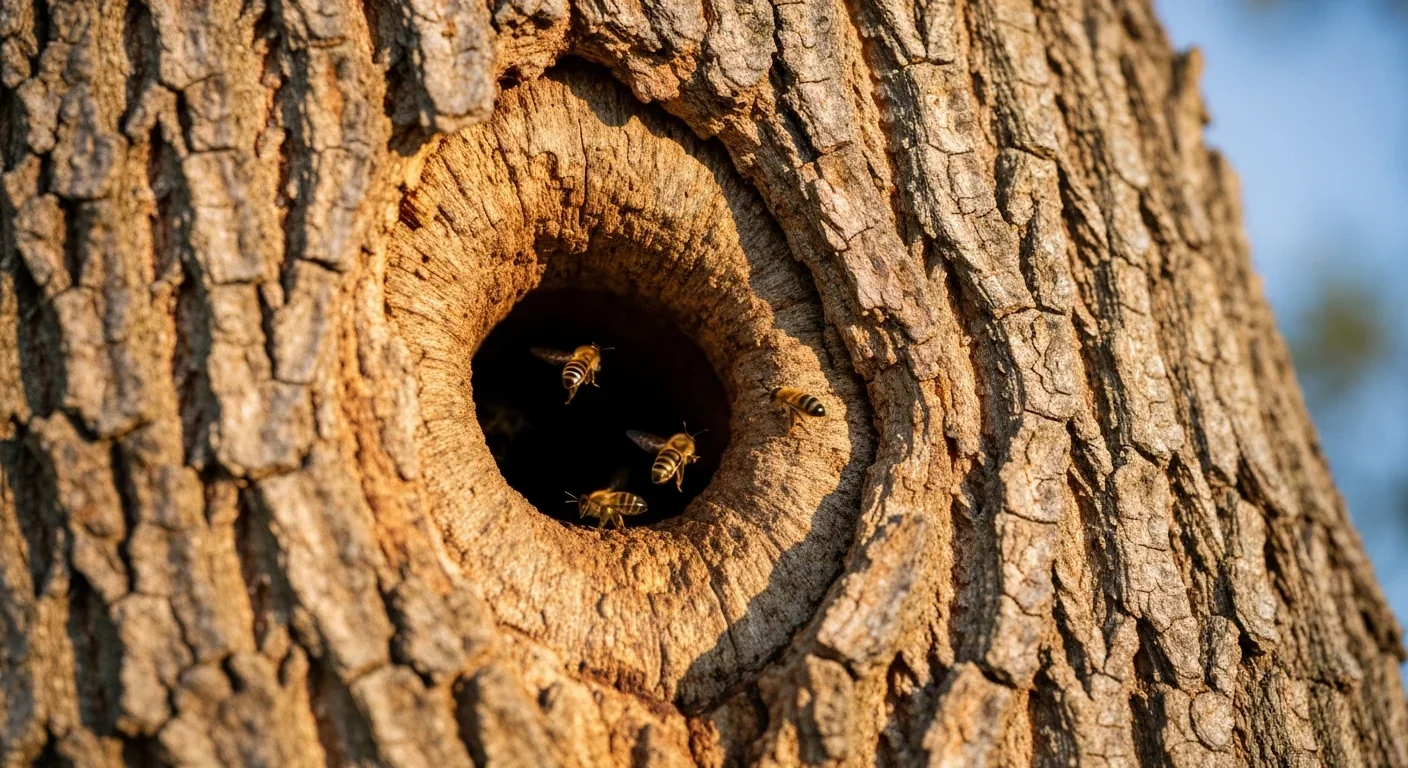
Only about 3 to 5 percent of the swarm becomes scouts, the most experienced foragers in the group. These several hundred bees fan out across the landscape, searching for potential nest sites. They're looking for very specific things: a cavity of at least 15 litres volume, preferably around 40 litres, with a small entrance near the bottom, protection from weather, some sun warmth, and no ant infestations. Sites with abandoned honeycomb are especially prized.
When a scout finds a promising site, she returns to the cluster and does something extraordinary. She performs a waggle dance on the surface of the swarm. This figure-eight pattern is one of the most sophisticated communication systems in the animal kingdom. The angle of the waggle run relative to vertical encodes the compass direction to the site, using the sun as a reference. The duration of the waggling encodes the distance. And the vigor of the dance, how rapidly and enthusiastically she waggles, encodes her assessment of quality.
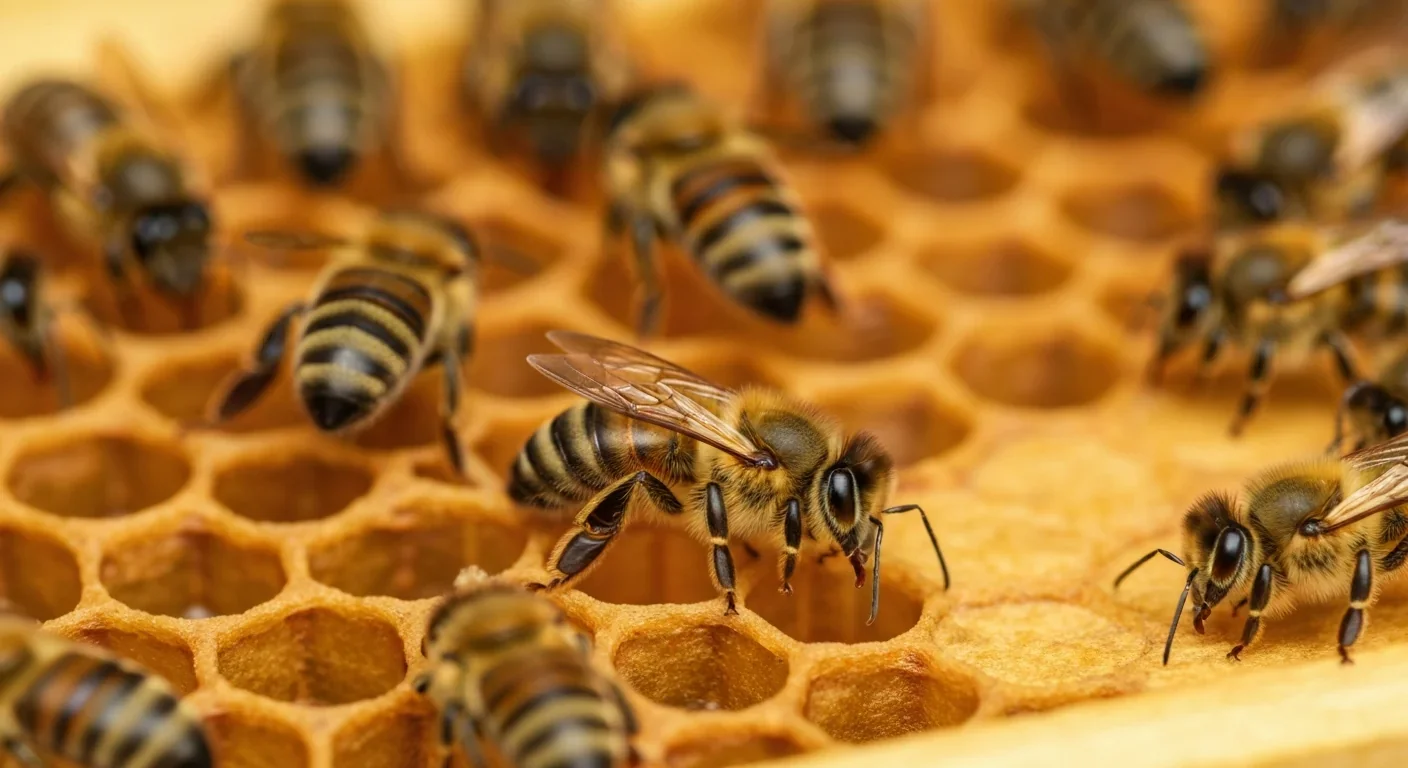
Here's where it gets political. The better the housing site, the stronger the waggle dance. In Seeley's controlled experiments, scouts made 100 dance circuits for a first-rate site versus just 12 for a mediocre one. That's an 8-to-1 ratio of enthusiasm. A scout who finds a cramped, drafty cavity barely bothers advertising it. A scout who finds the bee equivalent of a penthouse apartment dances with the fervor of a political candidate who knows she's going to win.
"This is a striking example of decision making by an animal group that is complicated enough to rival the dealings of any department committee."
- Thomas Seeley, Professor of Neurobiology and Behavior, Cornell University
And just like in politics, if multiple bees are doing the waggle dance, it's a competition to convince the observing bees to follow their lead. Competing bees may even disrupt other bees' dances. Different factions form around different sites, each faction campaigning to attract uncommitted scouts to inspect their preferred location.
What prevents this from becoming a shouting match where the loudest faction wins? A mechanism called quorum sensing, and it's a stroke of evolutionary genius.
As scouts recruit other scouts to visit their site, the number of bees visiting each candidate grows. A decision is made when around 80 percent of the scouts have agreed upon a single location, and when a quorum of roughly 15 to 30 scouts are physically present at one site simultaneously. The adaptive logic behind this specific threshold is elegant: if the swarm waited for less than 80 percent to agree, the bees would lack confidence in the site's suitability. If they waited for more than 80 percent, the swarm would waste its irreplaceable stored honey.
This threshold wasn't designed by an engineer. It was calibrated by millions of years of natural selection. Colonies that set the bar too low chose bad homes and died. Colonies that deliberated too long starved. The 80 percent threshold is what survived.
The quorum mechanism weights information by quality, not by volume. A scout who found a mediocre site gets 12 dance circuits. A scout who found a great site gets 100. The system is structurally blind to everything except quality.
The critical thing about quorum sensing is that it prevents premature consensus. Because scouts grade their recruitment signals in relation to site quality, the best site generates exponentially more recruitment than mediocre alternatives. Scouts build up most rapidly at the best site, not because anyone directed them there, but because the quality-weighted signaling naturally funnels attention toward the superior option.
Even more remarkably, the system is immune to first-mover advantage. In experiments where scouts discovered an inferior site first, the swarm almost always still ended up choosing the objectively best site. The quality signal always wins out over timing of discovery, a property that human voting systems, which suffer from name recognition effects and ballot order bias, often fail to achieve.
But what happens when two sites are equally good? In human politics, equal-quality candidates can produce paralyzing gridlock. Bees solved this problem too, and they did it with a mechanism scientists didn't even discover until 2011.
The stop signal is a brief buzz delivered by a scout while physically butting her head against a dancing bee. Published in the journal Science, research by Seeley, P. Kirk Visscher of UC Riverside, and colleagues revealed that these stop signals are delivered primarily by scouts who have visited the competing site. A bee who has inspected Site B will head-butt a dancer advocating Site A, essentially saying: "Hold on. There's something else worth considering."
As Visscher explained, "The message the sender scout is conveying to the dancer appears to be that the dancer should curb her enthusiasm, because there is another nest site worthy of consideration." This cross-inhibition prevents the swarm from locking into a suboptimal choice and ensures that even when two sites are of equal quality, random fluctuations eventually tip the balance toward one, allowing the swarm to converge.
Theoretical models by researchers at Sheffield University confirmed that this cross-inhibition is what prevents deadlock between equal-quality alternatives, a mathematically necessary feature for any decentralized decision system that must produce a single outcome.
Here's where the story takes an unexpected turn. The bee swarm's decision-making architecture isn't just analogous to democracy. It's structurally isomorphic to how primate brains make decisions.
Visscher put it directly: "It appears that the stop signals in bee swarms serve the same purpose as the inhibitory connections in the brains of monkeys deciding how to move their eyes in response to visual input." In both systems, units representing different alternatives, dancing bees or nerve centers, suppress each other's activity through cross-inhibition until one option dominates.
"In one case we have bees and in the other we have neurons that suppress the activity levels of units - dancing bees or nerve centers - that are representing different alternatives."
- P. Kirk Visscher, Professor of Entomology, University of California Riverside
This is convergent evolution of an algorithm. Across radically different biological substrates, insects and primates independently arrived at the same computational solution to the same fundamental problem: how does a distributed system with no central controller reliably choose among competing options?
The swarm even has a two-phase decision architecture. During deliberation, stop signals function as cross-inhibition between competing factions. But once a quorum is reached and piping begins, scouts start producing a vibrational signal by pressing their vibrating thorax against other bees, stimulating flight-muscle warm-up. At this point, the stop signal changes meaning entirely, from "consider the alternative" to "stop dancing, it's time to fly." The same signal carries two different messages depending on the swarm's collective state, and no central authority announces the phase change.
Seeley didn't keep these insights confined to entomology journals. He wrote "The Five Habits of Highly Effective Hives" for the Harvard Business Review, explicitly bridging bee research and human organizational science. His five principles of effective group decision-making, derived directly from bee swarm behavior, apply to any group trying to make smart collective choices:
Diversity of knowledge. Scout bees don't all inspect the same site. They spread out independently, ensuring the group considers the full range of available options. Human committees that draw on diverse perspectives outperform homogeneous groups for the same reason.
Open and honest sharing of information. The waggle dance is a public signal, visible to any bee on the swarm surface. There's no backroom dealing, no information hoarding. Every scout's assessment is broadcast openly.
Independent evaluations. Recruits don't just take a dancer's word for it. They fly out and inspect the site themselves before deciding whether to dance for it. This independent verification prevents information cascades where bad ideas gain momentum through social copying rather than genuine quality.

Unbiased aggregation. The quorum mechanism weights information by quality, not by status or seniority. The system is structurally blind to everything except quality.
Leadership that guides without dominating. The queen plays no role in nest-site selection. She simply goes where the swarm goes. The system achieves coordination through distributed local interactions, not top-down command.
As Seeley concluded in his American Scientist paper, these group decision-making methods, "which include an open forum of ideas, frank 'discussions' and friendly competition, just might help human committees achieve collective intelligence and thus avoid collective folly."
The practical impact of bee democracy extends well beyond biology. Seeley's fundamental research directly produced the Honeybee Algorithm, a formalized computational approach that earned him the Golden Goose Award in 2016, a prize specifically for basic research that produced unexpected societal benefits. The BeeHive routing algorithm, inspired by waggle dance principles, applies fault-tolerant, scalable, local-information-based routing to telecommunications networks, matching or outperforming conventional algorithms.
The Golden Goose Award specifically honors federally funded basic research that seemed impractical at the time but proved transformative. Seeley's bee democracy research winning it confirms that studying insect decision-making has real-world engineering value.
Bee colony optimization powers internet server allocation, dynamically distributing resources the way a swarm distributes scouts among sites. Even the ZigBee wireless protocol, used in smart home devices and IoT sensors worldwide, takes its name from the waggle dance. Swarm-based optimization algorithms now tackle vehicle routing, job scheduling, network design, and even AI training optimization.
The engineer on Seeley's original research team, Kevin Passino of Ohio State University, wasn't there by accident. The cross-disciplinary translation from biology to engineering was built into the research program from the start.
One of the most provocative theories about the waggle dance comes from Martin Lindauer, who proposed that the dance originally evolved to communicate nest-site locations during swarming, and was only later co-opted for foraging communication. If correct, bee democracy is phylogenetically older than bee food-finding. Collective decision-making may be the original purpose of one of nature's most sophisticated communication systems.
And quorum sensing itself is ancient beyond insects. Bacteria have used quorum sensing for billions of years to coordinate collective behavior. The core mechanism, assess local density, trigger response at threshold, is a convergently evolved solution that appears across kingdoms of life.
Yet there's an irony in the modern story of bee democracy. Commercial beekeeping practices routinely suppress swarming because swarms reduce honey production. In doing so, they may be disrupting the very collective intelligence system that evolution spent millions of years perfecting. Seeley's research at the 4,200-acre Arnot Forest in New York showed that wild bee colonies maintained stable population densities even after Varroa mite invasion, while managed colonies collapsed.
"Honey bees are superb beekeepers; they know what they're doing."
- Thomas D. Seeley, UC Davis Bee Symposium
What makes bee democracy genuinely different from human versions isn't just the absence of a leader. It's the structural alignment of individual and collective interests. Every bee in the swarm benefits maximally from choosing the best possible home. There are no factional interests, no lobbying budgets, no gerrymandering. The system works because the incentive structure is perfectly aligned, something human democracies continually struggle to achieve.
Seeley characterized the bee method as a product of "disagreement and contest rather than consensus or compromise" that "consistently yields excellent collective decisions." The lesson isn't that bees are harmonious. The lesson is that structured adversarial competition, when every participant honestly reports what they've found and the system weights quality over volume, produces better outcomes than either autocracy or polite consensus-seeking.
"Whether the quorum-setting method of aggregating independent opinions could substitute for a democratic vote remains to be seen," Seeley wrote, "but it sure could speed up the process toward a swift, but smart, decision."
Somewhere on a tree branch right now, a cluster of 15,000 bees is solving a problem that humans have spent centuries arguing about. They'll have an answer by tomorrow. And they'll almost certainly get it right.

Project Orion was a real 1960s program to reach other stars by detonating 800 nuclear bombs behind a spacecraft. The physics worked and the engineering was feasible, but the 1963 nuclear test ban treaty killed it. It remains the most credible interstellar spacecraft ever designed.

The locus coeruleus, a tiny brainstem structure, degenerates decades before Alzheimer's symptoms appear. Its loss cripples the brain's inflammation control, waste clearance, and sleep regulation. New imaging tools and noradrenergic therapies offer hope for early detection and prevention.

Research shows the sharing economy often increases total resource consumption through the Jevons paradox and rebound effects. Ride-sharing adds billions of vehicle miles, co-working spaces use more energy per worker, and diffused responsibility erodes conservation behavior. Breaking the paradox requires congestion pricing, accountability design, and matching sharing models to appropriate resource types.
Psychological reactance theory explains why banning or restricting things makes people want them more. From Prohibition to the Streisand effect to scarcity marketing, research shows that threatening people's freedom reliably backfires, and autonomy-supportive communication is far more effective.
A carnivorous pitcher plant in Borneo evolved to house bats instead of trapping insects, gaining up to 95% of its nitrogen from bat guano. The plant even built an ultrasonic reflector to help bats find it, revealing that carnivory in plants is a flexible spectrum.

The quantified self movement began as a hacker-ethos pursuit of personal insight, but corporate wearables now funnel biometric data to employers, insurers, and data brokers. With 81% of Americans wrongly believing health apps are HIPAA-protected, a regulatory void enables health data to be sold for pennies while generating anxiety instead of empowerment.

CXL memory pooling lets servers dynamically share DRAM over a cache-coherent interconnect, eliminating the 40% stranded memory waste in data centers. With commercial hardware now shipping and Azure deploying CXL cloud instances, this technology promises to cut memory costs by 50% while enabling composable infrastructure.

Loading featured articles...