Carnivorous Plant Farms Bat Poop Instead of Eating

TL;DR: Naked mole rats produce a giant form of hyaluronic acid that makes them virtually immune to cancer. Scientists have successfully transferred this gene to mice, extending their lifespan and reducing tumors, and are now developing compounds to replicate the effect in humans.
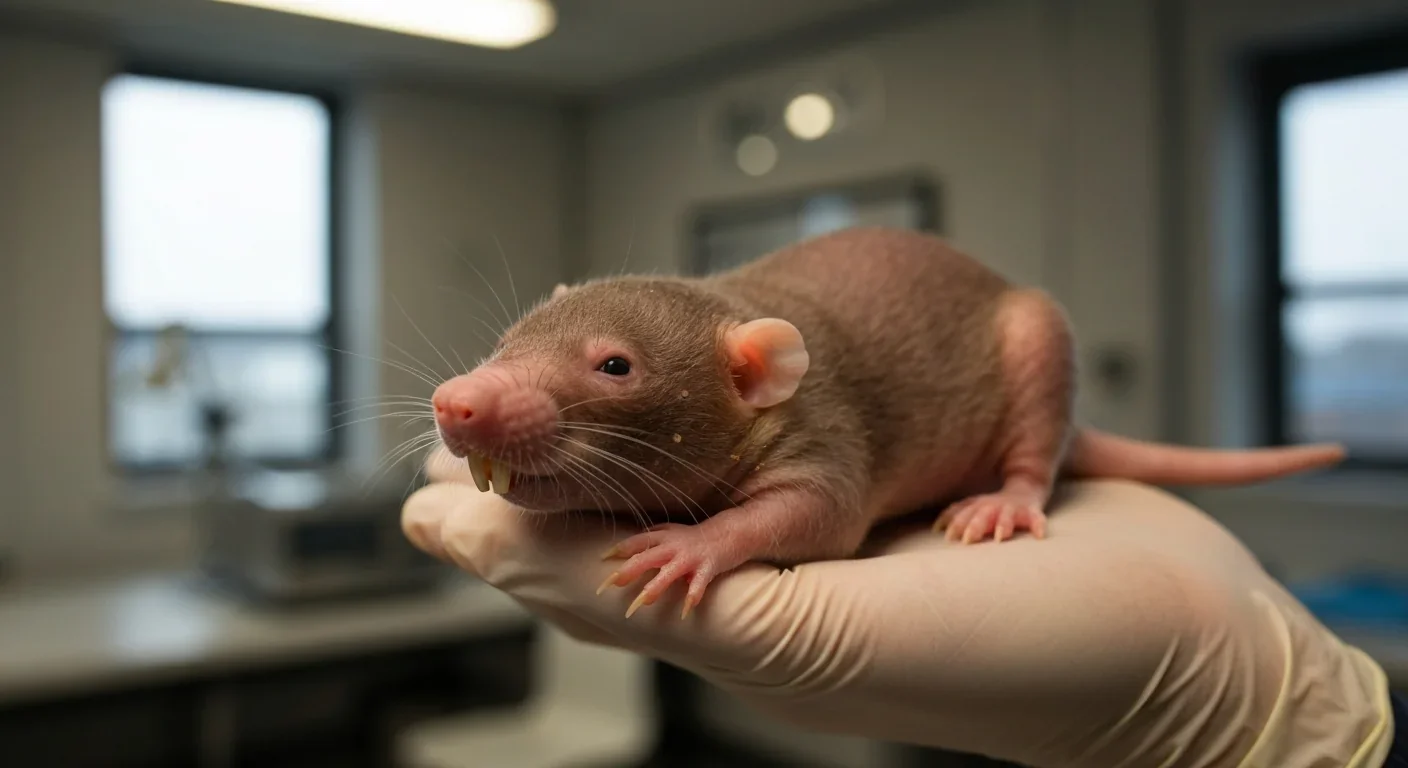
Imagine a world where cancer prevention comes not from a pharmaceutical lab but from a wrinkly, buck-toothed rodent that spends its entire life underground. That world is closer than you think. Scientists have spent over a decade studying the naked mole rat, a creature so bizarre it looks like a cross between a sausage and a walnut, and what they've found could fundamentally change how we fight one of humanity's most persistent killers. These tiny animals are virtually immune to cancer. And researchers are now figuring out how to borrow their biological armor for ourselves.
The breakthrough came from an unexpected place. In 2013, Vera Gorbunova and Andrei Seluanov at the University of Rochester published a landmark paper in Nature that identified the naked mole rat's secret weapon: a supercharged version of hyaluronic acid, a sugar-like molecule found in the connective tissues of all mammals.
You've probably heard of hyaluronic acid. It's the stuff in skin serums and joint injections. But the version naked mole rats produce is nothing like what you'd find in a beauty product. Their high-molecular-mass hyaluronan, or HMM-HA, is roughly five times larger than the human version, with a molecular mass of 6 to 12 megadaltons compared to our roughly 2 megadaltons. This isn't just a bigger molecule. It's a fundamentally different biological tool.
The naked mole rat's tissues are practically swimming in HMM-HA. They have about ten times more of it in their bodies than we do. And this gooey, viscous substance does something remarkable: it triggers a process called early contact inhibition, which stops cells from multiplying when they get too crowded. Think of it as a biological brake pedal that gets pressed much sooner than in human or mouse cells.
Naked mole rats have roughly ten times more high-molecular-mass hyaluronan in their bodies than humans do, and this molecule is five times larger than the human version, creating a biological shield that effectively halts uncontrolled cell growth.
Here's where it gets really interesting. Most mammals, including humans, have a mechanism called contact inhibition. When cells bump into each other, they receive signals to stop dividing. Cancer happens, in part, when cells ignore those signals and keep growing out of control.
Naked mole rat cells are different. They hit the brakes at much lower cell densities than mouse or human cells. This "early" contact inhibition is mediated by two key signaling pathways, p16-Ink4a and p27-Kip1, which act as a double-layered defense system. As Vera Gorbunova described it, the p16 gene makes cells "claustrophobic," stopping their proliferation when too many crowd together, cutting off runaway growth before it starts.
The critical proof came when researchers removed HMM-HA from naked mole rat cells or modified the HAS2 gene responsible for producing it. Without their sugar shield, the mole rats became susceptible to tumor formation. Their cells lost contact inhibition and began growing uncontrollably, just like cancer cells in other mammals. The discovery was so significant that Science magazine named it a Breakthrough of the Year runner-up in 2013.
What makes this mechanism particularly elegant is the genetic basis behind it. The naked mole rat's HAS2 gene contains two unique amino acid substitutions, serines replacing conserved asparagines, that make its hyaluronan synthase enzyme more processive. In simpler terms, the enzyme keeps churning out longer and longer chains of hyaluronic acid, producing those massive molecules that form such an effective barrier against cancer.
But why would evolution build such an elaborate cancer defense into a small rodent? The answer likely lies in the naked mole rat's extraordinary lifestyle. These animals live in underground colonies in East Africa, in a social structure that more closely resembles a beehive than a typical mammal family. They're one of only two known eusocial mammals, with a single breeding queen and dozens of workers.
Their subterranean world presents unique challenges: limited oxygen, high carbon dioxide, and constant heat. Living in these conditions for decades, as naked mole rats do, means their cells face enormous stress. A mouse of similar size lives maybe two years. Naked mole rats can live past 37 years, with some estimates pushing close to 40. That makes them the longest-lived rodent species known.
"Naked mole rats are fascinating creatures, not least because they are so long lived compared to other rodents of the same size. They also do not suffer from age associated disorders, such as cancer, dementia and neurological decline."
- Prof. Sherif El-Khamisy, University of Bradford
Perhaps the most astonishing thing is that they show virtually no age-related increase in mortality rate, defying the Gompertz-Makeham law that governs aging in virtually every other mammal studied. Only about 10 deaths from cancer among tens of thousands of captive naked mole rats have been documented over more than three decades of laboratory observation. That's a cancer rate so low it's practically zero.

The big question, of course, is whether this biology can work in other species. In 2023, Gorbunova and Seluanov's team took a bold step. They transferred the naked mole rat's HAS2 gene into mice using transgenic engineering. The results, published in Nature, were striking.
Mice carrying the naked mole rat version of the gene showed higher HMM-HA levels across multiple tissues, including muscle, kidney, intestine, heart, and skin. They had better protection against both spontaneous tumors and chemically induced skin cancer. And they lived longer, with a 4.4 percent increase in median lifespan.
But the benefits went far beyond cancer. The engineered mice showed reduced systemic inflammation, healthier gut microbiomes, increased bone density in aged females, and less transcriptomic dysregulation. In other words, these mice weren't just cancer-resistant. They were aging more gracefully across the board.
Mice engineered with the naked mole rat's HAS2 gene didn't just resist cancer, they showed reduced inflammation, better gut health, stronger bones, and a 4.4% increase in median lifespan. The benefits were system-wide.
"It took us 10 years from the discovery of HMW-HA in the naked mole rat to showing that HMW-HA improves health in mice," Gorbunova noted. That timeline matters because it shows both the promise and the patience required for this kind of translational research.

One of the most important recent findings is that HMM-HA isn't the naked mole rat's only trick. These animals have built a redundant network of cancer defenses that operates on multiple levels.
Researchers at Moffitt Cancer Center recently created the first genetically engineered cancer model in naked mole rats and discovered something remarkable. While a single genetic mutation is enough to cause lung cancer in mice, naked mole rats required three simultaneous oncogenic events, an EML4-ALK fusion plus the loss of both p53 and Rb1 tumor suppressors, to develop tumors. Even then, only 30 percent of the animals developed aggressive lung tumors.
Beyond hyaluronan, naked mole rats also possess unique ribosomal RNA structures with fragmented 28S rRNA that correlates with exceptionally high translational fidelity, meaning their cells make fewer protein-manufacturing errors. They have a modified version of the cGAS protein that promotes DNA repair rather than inhibiting it, and potent interferon responses and accelerated cellular senescence pathways that collectively suppress tumor growth.
"You can think of cGAS as a biological Lego piece, the same basic shape in humans and naked mole rats, but in the mole rat version a few connectors are flipped, allowing it to assemble an entirely different structure and function."
- Gabriel Balmus, Clinical Neuroscientist, University of Cambridge
So how do we get from underground rodents to human cancer prevention? Gorbunova's team has laid out two practical strategies: increase the synthesis of HMM-HA in human tissues, or slow down its degradation. Both approaches are now being pursued.
On the degradation side, the team has identified that hyaluronidase HYAL2 activity is markedly reduced in naked mole rat tissues compared with mice, which helps maintain their massive HMM-HA levels. They've also discovered a promising compound called delphinidin, an anthocyanidin pigment found in common fruits and vegetables, that inhibits hyaluronidases and increases HMM-HA levels in cells and mouse tissues. In early studies, delphinidin reduced cancer cell migration and suppressed melanoma metastasis.
"We already have identified molecules that slow down hyaluronan degradation and are testing them in pre-clinical trials," Seluanov said.
But significant challenges remain. Gene therapy approaches would need to precisely regulate the timing and quantity of HMM-HA production in human tissues, much like the tamoxifen-controlled system used in the mouse experiments. Hyaluronic acid has a complicated dual nature in cancer biology: while a strong extracellular matrix can protect against cancer, some tumors actually use hyaluronic acid as fuel. Pancreatic cancer cells, for instance, feed on it to support their growth. Getting the molecular size right, and keeping it right, will be essential.
The naked mole rat story is really a story about looking in unexpected places for medical breakthroughs. A decade ago, the idea that a bizarre, underground rodent could teach us how to prevent cancer seemed almost laughable. Today, mice engineered with a single naked mole rat gene are living longer, healthier lives with dramatically fewer tumors.
As Seluanov has said, "We hope that our findings will provide the first, but not the last, example of how longevity adaptations from a long-lived species can be adapted to benefit human longevity and health." Gorbunova echoed the ambition: "Our next goal is to transfer this benefit to humans either by slowing down degradation of HMM-HA or by enhancing its synthesis."
Within the next decade, you'll likely see clinical trials testing HMM-HA-based therapies in humans. Whether through gene therapy, pharmacological compounds like delphinidin, or entirely new approaches, the naked mole rat's molecular armor is being reverse-engineered for human use. The wrinkliest, most improbable creature in the animal kingdom might just hold the key to one of medicine's oldest quests. And that should make us think twice about which species we dismiss as unglamorous.

Project Orion was a real 1960s program to reach other stars by detonating 800 nuclear bombs behind a spacecraft. The physics worked and the engineering was feasible, but the 1963 nuclear test ban treaty killed it. It remains the most credible interstellar spacecraft ever designed.

The locus coeruleus, a tiny brainstem structure, degenerates decades before Alzheimer's symptoms appear. Its loss cripples the brain's inflammation control, waste clearance, and sleep regulation. New imaging tools and noradrenergic therapies offer hope for early detection and prevention.

Research shows the sharing economy often increases total resource consumption through the Jevons paradox and rebound effects. Ride-sharing adds billions of vehicle miles, co-working spaces use more energy per worker, and diffused responsibility erodes conservation behavior. Breaking the paradox requires congestion pricing, accountability design, and matching sharing models to appropriate resource types.

Psychological reactance theory explains why banning or restricting things makes people want them more. From Prohibition to the Streisand effect to scarcity marketing, research shows that threatening people's freedom reliably backfires, and autonomy-supportive communication is far more effective.
A carnivorous pitcher plant in Borneo evolved to house bats instead of trapping insects, gaining up to 95% of its nitrogen from bat guano. The plant even built an ultrasonic reflector to help bats find it, revealing that carnivory in plants is a flexible spectrum.

The quantified self movement began as a hacker-ethos pursuit of personal insight, but corporate wearables now funnel biometric data to employers, insurers, and data brokers. With 81% of Americans wrongly believing health apps are HIPAA-protected, a regulatory void enables health data to be sold for pennies while generating anxiety instead of empowerment.

CXL memory pooling lets servers dynamically share DRAM over a cache-coherent interconnect, eliminating the 40% stranded memory waste in data centers. With commercial hardware now shipping and Azure deploying CXL cloud instances, this technology promises to cut memory costs by 50% while enabling composable infrastructure.

Loading featured articles...