Carnivorous Plant Farms Bat Poop Instead of Eating

TL;DR: Fireflies synchronize their flashing through simple local rules explained by pulse-coupled oscillator mathematics, with no leader or central clock. Engineers now copy this same framework to build self-organizing wireless networks, robotic swarms, and resilient distributed systems.
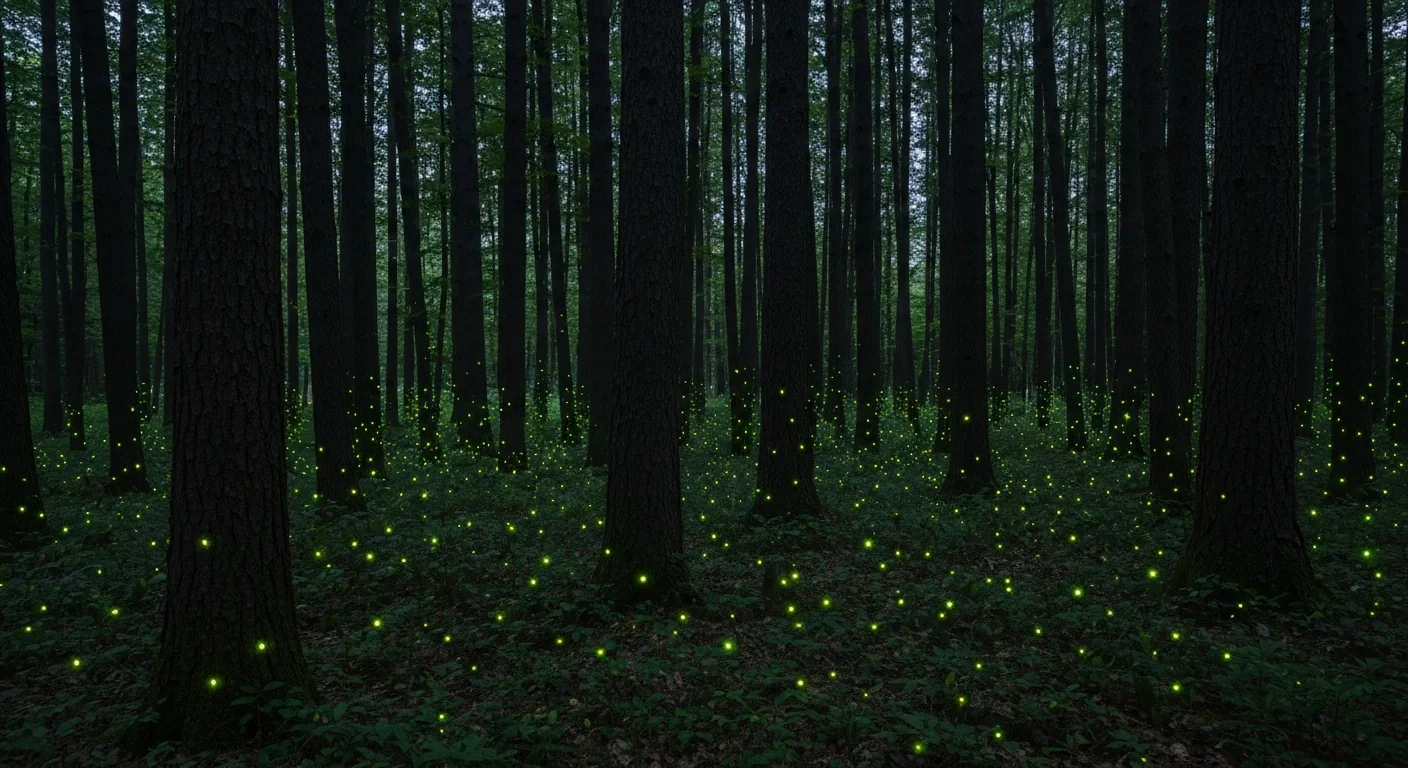
Imagine standing in a dark Appalachian forest at 10 PM on a humid June night, watching thousands of tiny lights blink on and off in perfect unison, as if the entire valley were breathing. No conductor. No master clock. No signal tower. Just bugs, following one simple rule: adjust your flash to match your neighbor's. That rule, repeated across thousands of individuals, produces one of nature's most stunning displays of spontaneous order. And it turns out the math behind it is now shaping everything from wireless networks to heart medicine.
For most of the 20th century, Western scientists didn't believe synchronous fireflies existed. Reports from travelers in Southeast Asia describing entire riverbank trees pulsing with light were dismissed as optical illusions or wishful thinking. It wasn't until biologists actually visited the mangrove forests of Thailand and Malaysia that the phenomenon became impossible to deny.
Males of species like Pteroptyx malaccae and Pteroptyx tener gather by the thousands on single trees, flashing three times per second in perfect lockstep, visible from hundreds of meters away.
In North America, the story centers on a single species: Photinus carolinus, the synchronous firefly of the Great Smoky Mountains. Every late May and early June, males fly above the forest floor near Elkmont, Tennessee, producing bursts of four to eight bright flashes over two to four seconds, followed by a dark pause of eight to twelve seconds. Then, as if someone flipped a switch, they all go dark together.
The National Park Service runs a lottery to manage the crowds, issuing just 120 vehicle passes per night across an eight-day window. Tickets vanish almost instantly.
But the real puzzle isn't the spectacle itself. It's how it happens without anyone in charge.
The breakthrough came from mathematics, not biology. In 1975, Japanese physicist Yoshiki Kuramoto proposed a model for how coupled oscillators, things that tick at their own natural rhythm, could spontaneously lock into sync. His equation was elegant: each oscillator adjusts its phase based on the sine of its phase difference with every other oscillator. When the coupling strength crosses a critical threshold, the whole population snaps into coherence.
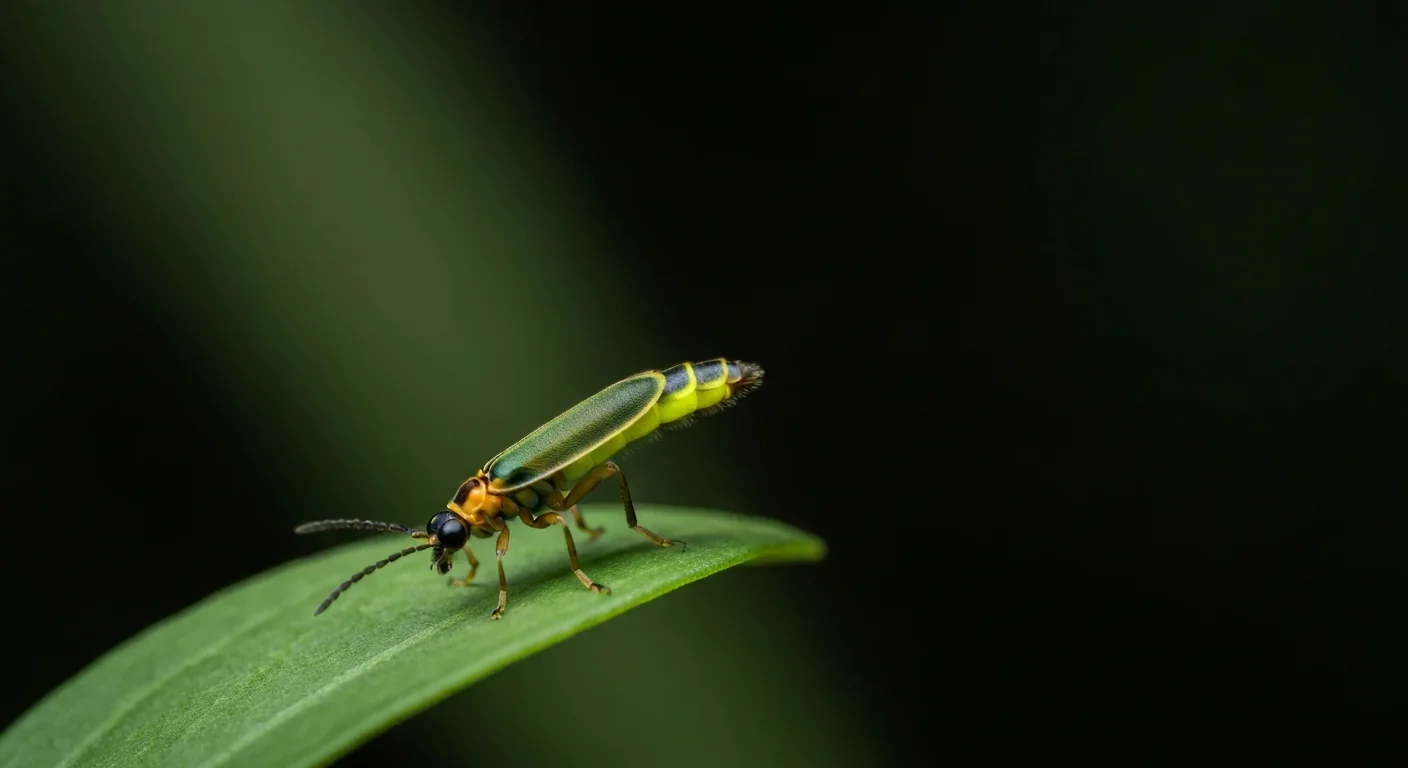
Then in 1990, mathematicians Renato Mirollo and Steven Strogatz proved something even more remarkable. They showed that for pulse-coupled oscillators, systems where each unit sends a brief "kick" to its neighbors at a specific moment in its cycle, synchronization was essentially inevitable. Given enough time and almost any starting configuration, every oscillator in the network would converge to firing at the same instant. No leader required. No global information needed. Just local interactions, iterated over and over.
Mirollo and Strogatz proved that for pulse-coupled oscillators, synchronization is essentially inevitable. No leader, no global information, just local interactions repeated over time.
This is exactly what fireflies do. Research from the Peleg Lab at the University of Colorado Boulder has shown the mechanism with startling precision. When scientists exposed individual male fireflies to a dim LED light in a completely darkened tent, the insects adjusted their flash rhythm to match the artificial pulse. If the LED blinked faster, the firefly sped up. If it blinked slower, the firefly slowed down. And the adjustment was sharpest when the LED fired just before or just after the firefly's own flash, a narrow window of sensitivity that mathematicians call a phase response curve.
"Think of it like an audience member in a crowded concert hall who is trying to join others clapping along to the beat."
- Orit Peleg, Associate Professor, University of Colorado Boulder
A 2023 study published in eLife added another layer. Each firefly behaves as a stochastic oscillator, waiting a slightly random interval before flashing. In groups, the earliest flash in a cycle triggers others to fire nearly simultaneously, collapsing individual randomness into a collective rhythm. The disorder at the micro level is what enables the order at the macro level.
Synchronization isn't just a mathematical curiosity for these insects. It's a survival strategy. In a landmark experiment, researchers Andrew Moiseff and Jonathan Copeland used arrays of LEDs to simulate groups of flashing males. They found that female fireflies responded far more often to synchronized displays than to random ones, with response rates exceeding 80% for synchronous flashing.
When the males are in sync, females can clearly distinguish the species-specific pattern against the background noise of other firefly species and ambient light. Males of Photinus carolinus gather in groups called "leks" and flash synchronously to attract females to their area.

The phenomenon isn't limited to insects on land. Marine ostracods, sometimes called "sea fireflies," synchronize their bioluminescent mating displays in the waters off Panama. Males secrete packets of glowing mucus in coordinated sequences during nautical twilight, but only on moonless nights. Despite sharing a common ancestor with terrestrial fireflies roughly 500 million years ago, their courtship-by-light likely evolved independently about 20 million years ago, a striking case of convergent evolution.
Here's where the story gets genuinely mind-expanding. The mathematics that explains firefly synchrony doesn't just apply to insects. The same pulse-coupled oscillator framework describes how cardiac pacemaker cells coordinate your heartbeat.
In your heart's sinoatrial node, roughly 10,000 pacemaker cells generate their own electrical rhythms. They're connected to neighboring cells through gap junctions, tiny protein channels that allow ions to flow between cells. When one cell fires, it nudges its neighbors to fire slightly sooner, exactly the same local adjustment rule that fireflies follow. The result is a coordinated contraction that pumps blood through your body, sixty to a hundred times per minute, without any central timing signal.
Research using modified Kuramoto models for cardiac cells has revealed something counterintuitive: a diversity of intrinsic frequencies among pacemaker cells actually promotes synchronization. When all cells tick at exactly the same rate, they paradoxically have a harder time locking in. Some variation provides the "grip" that coupling needs to pull the population together.
Frequency diversity can matter more than coupling strength for achieving synchronization, a counterintuitive finding with implications for both biology and network engineering.
The model extends further still. Neurons synchronize to produce brain waves. Power grids must maintain phase coherence across hundreds of generators. Even audiences clapping in unison after a concert follow pulse-coupled dynamics. The Kuramoto framework provides a unified lens for understanding synchronization across systems as different as a forest full of beetles and a human heart.
If fireflies can synchronize without a leader, so can your devices. That insight has launched an entire branch of engineering.
In wireless sensor networks, the challenge is brutal: thousands of tiny, low-power nodes need to coordinate their transmissions without a central clock. Traditional approaches rely on GPS signals or master nodes that broadcast timing information. But what happens when GPS isn't available, or the master node fails? Researchers have turned to firefly-inspired pulse-coupled oscillator protocols where each sensor node acts like a firefly, broadcasting a timing pulse and adjusting its own clock based on pulses received from neighbors.
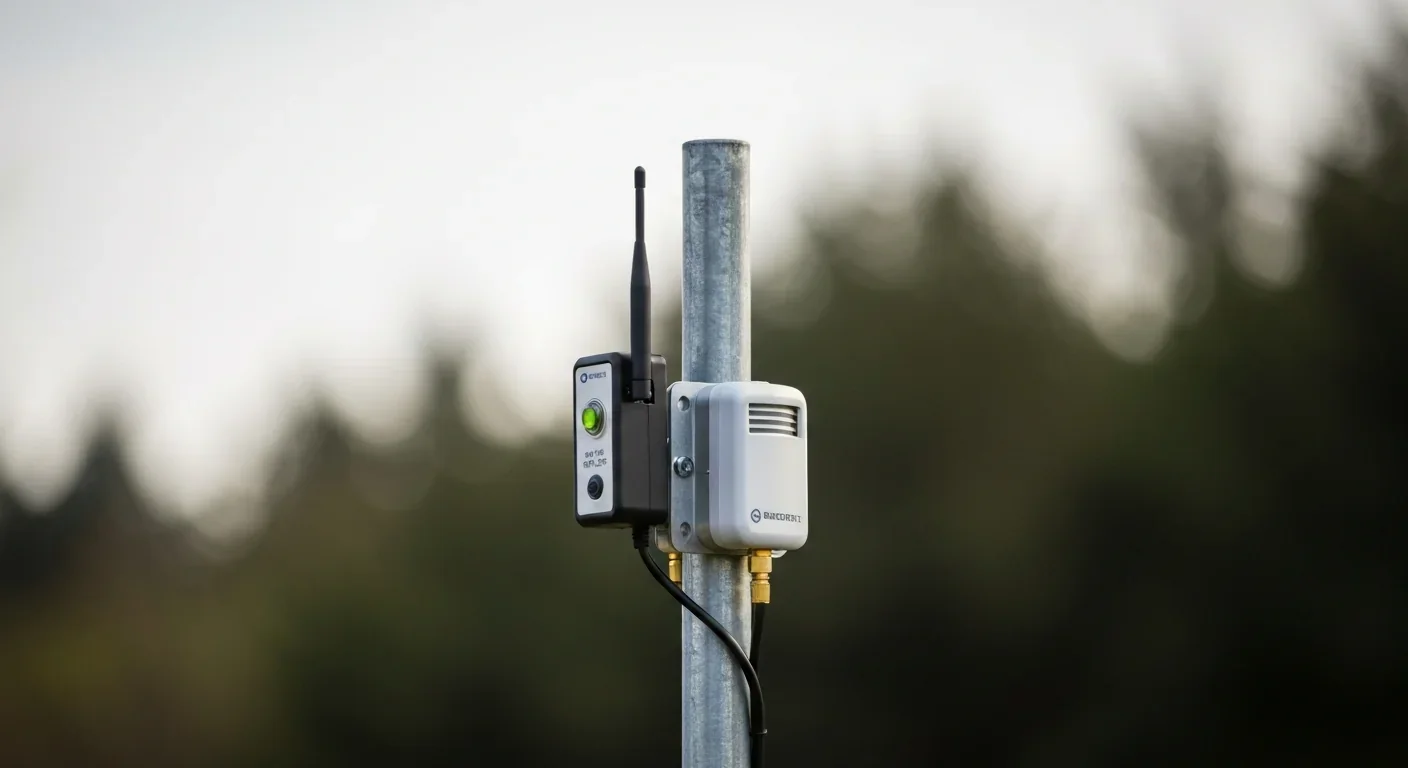
The results are impressive. Simulations and real-world tests on MOTE MICAz hardware have shown that pulse-coupled protocols generate only 1 to 6% of the messages required by conventional directed diffusion methods, while extending network lifetime from 265 to over 2,700 time units. The nodes self-organize into traveling waves of communication, sleeping when not needed and waking just in time to relay data.
The system adapts automatically to node failures, additions, or removals, no reconfiguration needed. Routing algorithms inspired by firefly behavior have shown similar promise. The F-LSL protocol reduced average packet loss by roughly 47% compared to conventional routing while cutting end-to-end delay by about 20 milliseconds.
At Harvard's Wyss Institute, researchers have programmed swarms of 1,024 Kilobots, small disc-shaped robots, to perform firefly-inspired synchronization. The robots communicate using infrared light, adjusting their blink timing based on signals from their nearest neighbors until the entire swarm pulses as one. The technology has been licensed for research and educational use, a step toward autonomous robot teams that can coordinate without any centralized command structure.
"If you're trying to get a lot of robots to push a large object, and they're pushing at different times, then they're going to struggle. One could imagine that firefly-inspired algorithms can lead to self-organized wireless sensor networks."
- Orit Peleg, University of Colorado Boulder
The same darkness that enables firefly synchronization is disappearing. Light pollution is now recognized as one of the most significant threats to firefly populations worldwide. Artificial light at night interferes with the flash-based courtship signaling that these species depend on. Males can't see female responses. Females can't distinguish species-specific patterns. The entire mating system breaks down.
A 2020 study in BioScience identified light pollution, habitat loss, and pesticide use as the three greatest threats to firefly survival globally. Of the more than 2,600 known firefly species, only about 150 have been formally assessed by the IUCN. "Our night skies are just getting brighter every year," says Candace Fallon of the Xerces Society.
In Southeast Asia, mangrove destruction for shrimp farming and urbanization has reduced populations of synchronizing Pteroptyx species. The first report of their synchronized displays was recorded in Thailand over a century ago, and the forests they depend on have been shrinking ever since. In Malaysia, community-driven conservation programs that combine guided tours with mangrove replanting have shown that protecting habitats directly supports the conditions necessary for synchronous flashing.
There's a practical mitigation strategy, too. Research shows that red LED lighting does not disrupt firefly communication the way white or blue-rich LEDs do. Switching outdoor lighting to warmer, redder wavelengths near firefly habitats could preserve their signaling environment at minimal cost.
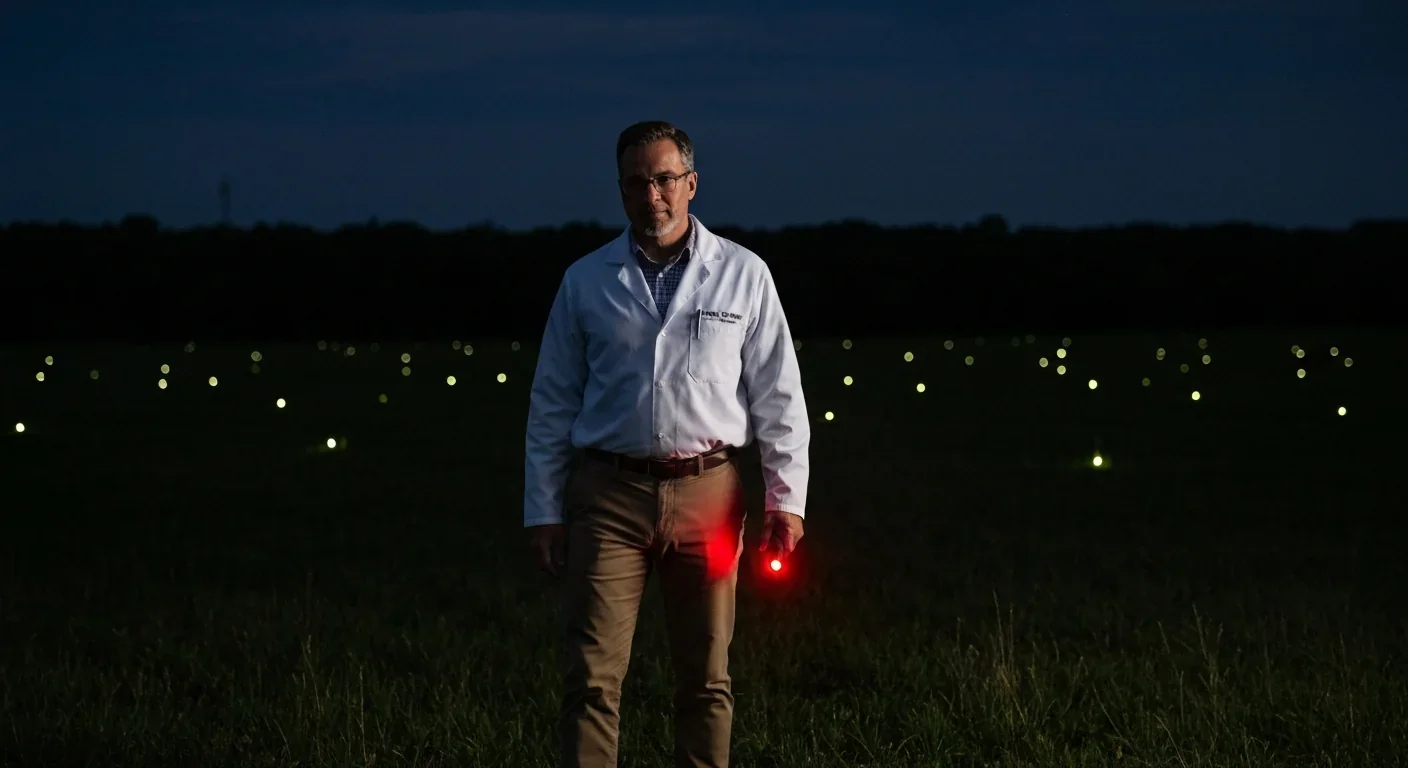
Despite decades of progress, significant questions remain open. How do environmental factors like temperature, humidity, and population density interact to set the threshold for synchronization? Field observations confirm that fireflies in the Great Smoky Mountains need warm, humid evenings above 50 degrees Fahrenheit, but the precise relationship between climate variables and coupling dynamics is still being mapped.
Recent mathematical work suggests even more surprises ahead. Studies of proportional coupling in Kuramoto networks have shown that when coupling strength varies based on frequency differences between oscillators, the synchronization transition becomes explosive, snapping from disorder to order almost instantaneously. This could explain why firefly synchrony sometimes seems to emerge from nowhere in just a few flash cycles.
And intriguingly, even networks using only 20% of possible connections can achieve full synchronization under this scheme, suggesting that fireflies don't need to see every neighbor to sync.
Research on higher-order interactions in oscillator networks reveals that groups of three or more oscillators interacting simultaneously can produce qualitatively different dynamics than pairwise interactions alone, including explosive transitions and bistable states. Whether fireflies exploit these higher-order effects remains an open question with implications for both ecology and network engineering.
What makes the firefly story so compelling isn't just the biology or the math or the engineering. It's the idea that complexity doesn't require a designer. Thousands of simple agents, each following a basic rule about adjusting their timing, produce a coordinated pattern that looks planned but isn't. No blueprint. No hierarchy. No central intelligence.
The next generation of IoT networks, autonomous vehicle fleets, and distributed computing architectures may owe more to a beetle in a Tennessee forest than to any human architect.
That principle is quietly reshaping how we think about building resilient systems. The next generation of IoT networks, autonomous vehicle fleets, and distributed computing architectures may owe more to a beetle in a Tennessee forest than to any human architect. Within the next decade, the devices in your home will likely coordinate their activity using algorithms descended from firefly math, synchronizing power consumption, data transmission, and sensor readings without ever needing a central server.
As Raphael De Cock, a Belgian firefly researcher, put it with quiet optimism: "There is always in the darkness a flash of hope." The fireflies have been proving that for millions of years.

Project Orion was a real 1960s program to reach other stars by detonating 800 nuclear bombs behind a spacecraft. The physics worked and the engineering was feasible, but the 1963 nuclear test ban treaty killed it. It remains the most credible interstellar spacecraft ever designed.

The locus coeruleus, a tiny brainstem structure, degenerates decades before Alzheimer's symptoms appear. Its loss cripples the brain's inflammation control, waste clearance, and sleep regulation. New imaging tools and noradrenergic therapies offer hope for early detection and prevention.

Research shows the sharing economy often increases total resource consumption through the Jevons paradox and rebound effects. Ride-sharing adds billions of vehicle miles, co-working spaces use more energy per worker, and diffused responsibility erodes conservation behavior. Breaking the paradox requires congestion pricing, accountability design, and matching sharing models to appropriate resource types.

Psychological reactance theory explains why banning or restricting things makes people want them more. From Prohibition to the Streisand effect to scarcity marketing, research shows that threatening people's freedom reliably backfires, and autonomy-supportive communication is far more effective.
A carnivorous pitcher plant in Borneo evolved to house bats instead of trapping insects, gaining up to 95% of its nitrogen from bat guano. The plant even built an ultrasonic reflector to help bats find it, revealing that carnivory in plants is a flexible spectrum.

The quantified self movement began as a hacker-ethos pursuit of personal insight, but corporate wearables now funnel biometric data to employers, insurers, and data brokers. With 81% of Americans wrongly believing health apps are HIPAA-protected, a regulatory void enables health data to be sold for pennies while generating anxiety instead of empowerment.

CXL memory pooling lets servers dynamically share DRAM over a cache-coherent interconnect, eliminating the 40% stranded memory waste in data centers. With commercial hardware now shipping and Azure deploying CXL cloud instances, this technology promises to cut memory costs by 50% while enabling composable infrastructure.

Loading featured articles...