Carnivorous Plant Farms Bat Poop Instead of Eating
TL;DR: Eastern skunk cabbage generates its own body heat through the alternative oxidase pathway, maintaining temperatures up to 35°C above freezing air and melting surrounding snow. This thermogenic ability, shared by roughly 90 plant species worldwide, reveals a level of metabolic sophistication that challenges assumptions about plant passivity.

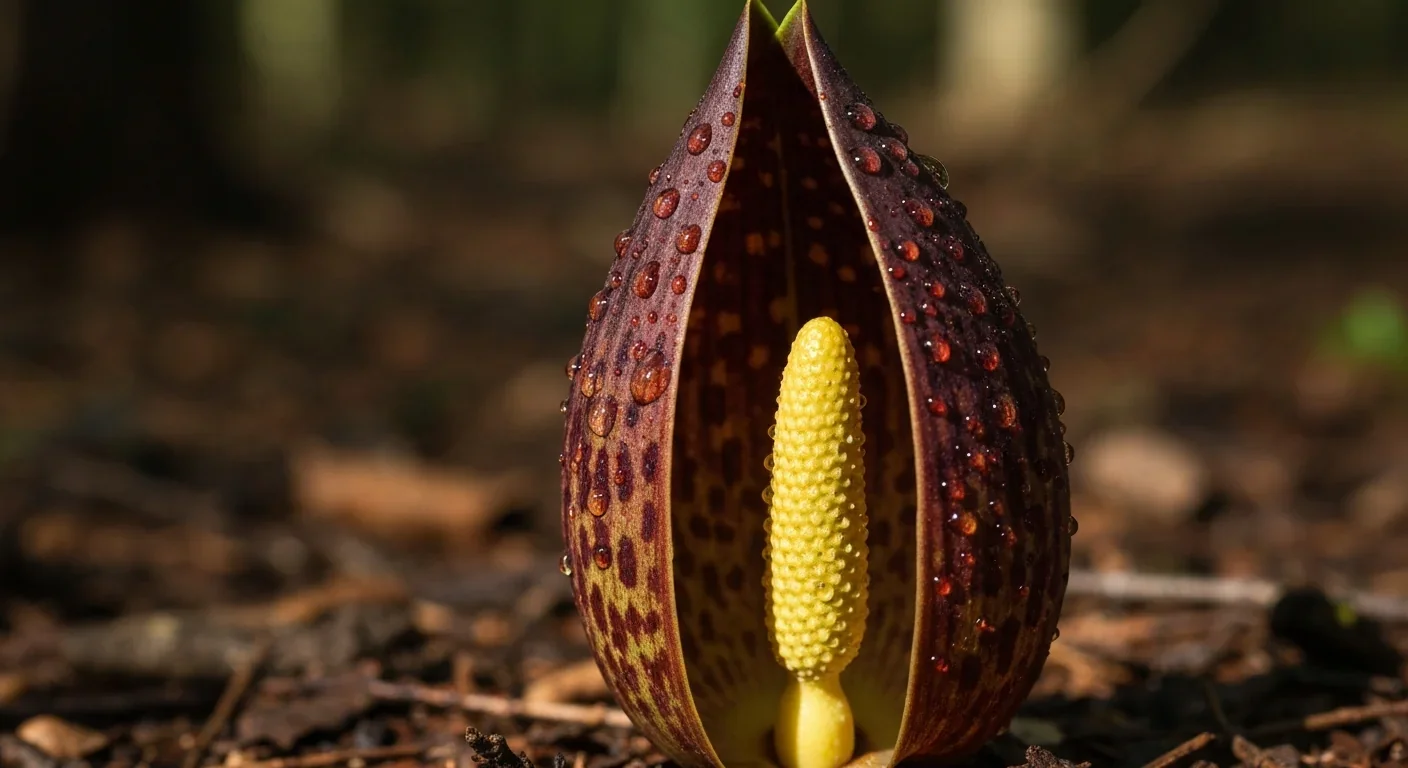
Imagine walking through a frozen wetland in February, snow covering every surface, and stumbling across something that shouldn't be possible: a plant pushing through the ice, surrounded by a perfect circle of melted ground, steam curling from its flower into the frigid air. No geothermal vent, no underground pipe. Just a living organism generating its own body heat, maintaining internal temperatures warm enough to liquefy ice, attract insects, and get a competitive head start on every other plant in the forest. The Eastern skunk cabbage (Symplocarpus foetidus) is one of the most thermodynamically remarkable organisms on the planet, and it's been hiding in plain sight in North American wetlands for millennia.
What this unassuming swamp dweller reveals about the sophistication of plant life is forcing scientists to rethink assumptions that have held for centuries. Plants aren't the passive, cold organisms we were taught about in school. Some of them run metabolic furnaces that would make a small mammal jealous.
The data on skunk cabbage thermogenesis reads like a misprint. The plant's spadix, the dense flowering structure nestled inside a hood-shaped spathe, can maintain temperatures 15 to 35°C above the surrounding air. When it's -15°C outside, the inside of this plant can sit at a comfortable 20°C. Its metabolic rate during peak heat production rivals that of a small mammal, consuming oxygen at a rate comparable to a shrew of similar mass.
And it does this not for hours, but for weeks. The plant sustains its internal furnace throughout the entire flowering period, burning through massive starch reserves stored in its underground rhizome. Once flowering ends, it shifts strategy entirely, unfurling enormous leaves that can exceed a meter in length to photosynthesize and rebuild its energy stores for the following winter.
What makes this even more extraordinary is the precision. This isn't just a plant that gets hot. It actively thermoregulates. In 1974, biologist Roger Knutson published a landmark paper in Science demonstrating that skunk cabbage maintains its spadix temperature with a stability comparable to warm-blooded animals. The spadix doesn't simply heat up and cool down passively. It oscillates, adjusting heat output in response to ambient temperature changes through a sophisticated feedback loop.
For a kingdom of life we tend to think of as basically inert, this level of dynamic self-regulation is a genuine paradigm shift.
During peak thermogenesis, skunk cabbage consumes oxygen at a rate comparable to a small mammal of the same size, burning through stored starch reserves to maintain spadix temperatures up to 35°C above freezing ambient air.
The story of plant thermogenesis stretches back over 250 years. In the 1770s, Jean-Baptiste Lamarck noticed that Arum flowers felt warm to the touch, a peculiar observation that lingered at the margins of botanical science for centuries. The idea that plants could generate heat seemed almost contradictory in a framework that drew hard lines between the kingdoms of life: animals were warm and active, plants were cold and passive.
That framework started to crack in the twentieth century. Researchers began measuring temperatures inside thermogenic flowers with increasing precision. But it was Knutson's 1974 work that changed the field. By taking continuous temperature readings of skunk cabbage spadices in the wild, he demonstrated that the plant didn't just produce heat as a byproduct of metabolism. It actively regulated its internal temperature, compensating for drops in ambient air by increasing its metabolic output and throttling back when conditions warmed.
This was, in biological terms, genuinely shocking. Thermoregulation was supposed to be the exclusive province of endothermic animals, birds and mammals. Finding it in a wetland plant forced a fundamental rethinking of what plants were capable of.
The molecular story took longer to unravel. Scientists identified the alternative oxidase (AOX) enzyme as the key player in the heat-generation machinery. In 2004, Ito and colleagues published research in Plant and Cell Physiology showing that skunk cabbage employs temperature-triggered oscillations, essentially a thermostat-like system that pulses heat production to maintain stable temperatures. In 2008, Onda and collaborators demonstrated the functional co-expression of both AOX and uncoupling proteins in the thermogenic florets, confirming a dual-enzyme system for generating and fine-tuning heat output.
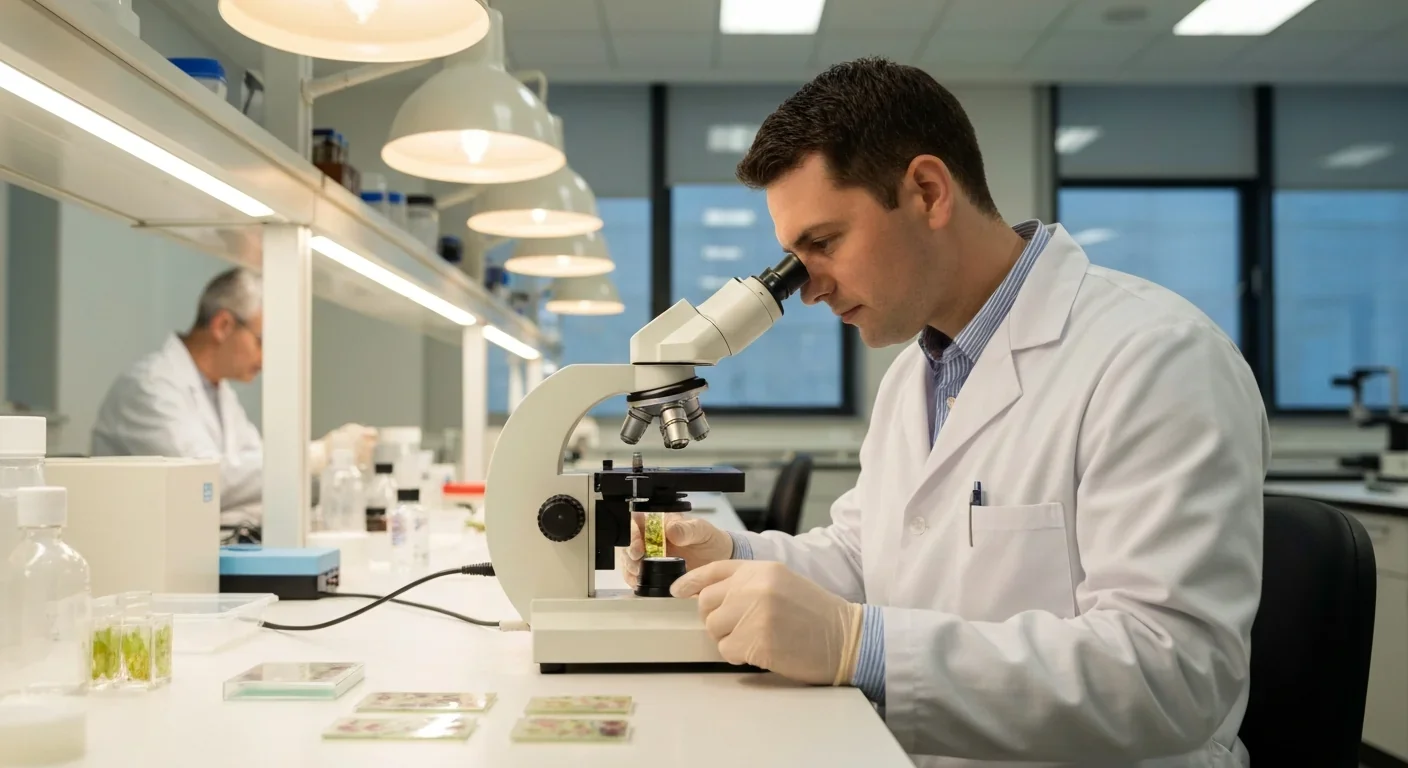
More recently, researchers have used oxygen isotope discrimination to quantify exactly how much respiratory flux passes through the alternative pathway versus the normal cytochrome oxidase route. The answer, during peak thermogenesis: over 90% of all electron flow in the mitochondria takes the heat-producing detour.
"All plants seem to have the heater enzyme, even non-thermogenic species. It's found in bacteria, fungi, even some primitive animals."
- Anthony Moore, University of Sussex and University of Padova
To understand how a plant generates heat, you need to understand what it's deliberately not doing. In normal cellular respiration, electrons pass through a chain of protein complexes in the mitochondria, pumping protons across a membrane to create a gradient that drives ATP synthesis. Energy goes in, chemical fuel comes out.
The alternative oxidase pathway short-circuits this entire process. AOX accepts electrons directly from ubiquinone (coenzyme Q) and transfers them to oxygen, producing water but bypassing the proton-pumping steps entirely. The energy that would have been stored as ATP is instead released as heat. Think of it like a power plant that deliberately vents steam instead of turning turbines. Wildly inefficient from an energy-storage perspective, but that's precisely the point.
Skunk cabbage can divert 75 to 90% of its respiration through this alternative pathway during peak flowering. The fuel comes entirely from starch reserves in the rhizome, the underground stem that acts as the plant's energy battery. After weeks of burning through these reserves, it unfurls enormous leaves to photosynthesize and rebuild for the next winter.
The AOX enzyme isn't unique to thermogenic plants. It exists in virtually all plants, most fungi, many bacteria, and even primitive animals like sponges. As Anthony Moore of the University of Sussex has observed, the enzyme's distribution across the tree of life suggests it arose very early in evolution. What makes thermogenic plants special isn't possessing the enzyme but having learned to crank it up to extraordinary levels and regulate it with precision.
That regulation involves genuine sophistication. AOX shifts between active and inactive forms, modulated by the redox state of the cell and by gene-level control. When ambient temperatures drop, the plant increases AOX expression; when temperatures rise, it throttles back. The result is a temperature-sensing, heat-adjusting system that parallels what you'd find in the hypothalamus of a mammal.
Why would any organism spend this much energy making heat when it could be growing instead? The answer lies in timing, chemistry, and reproduction.
Skunk cabbage is among the very first plants to flower each year, often appearing in January or February while the forest floor is still buried in snow. By generating heat, it melts the snow around it, creating small green oases in a frozen landscape. This gives it exclusive access to the earliest pollinators: flies, gnats, carrion beetles, and other cold-season insects that would otherwise have nowhere warm to go.
The heat also serves as a chemical amplifier. The spadix volatilizes the plant's signature compounds, particularly dimethyl disulfide and isoamyl isovalerate, which produce its distinctive rotting-meat odor. Warm air rises and carries these volatile attractants farther than they could travel in cold, still conditions. The spathe acts as a passive heat shield, concentrating warmth around the spadix and creating a microclimate detectable from a distance.
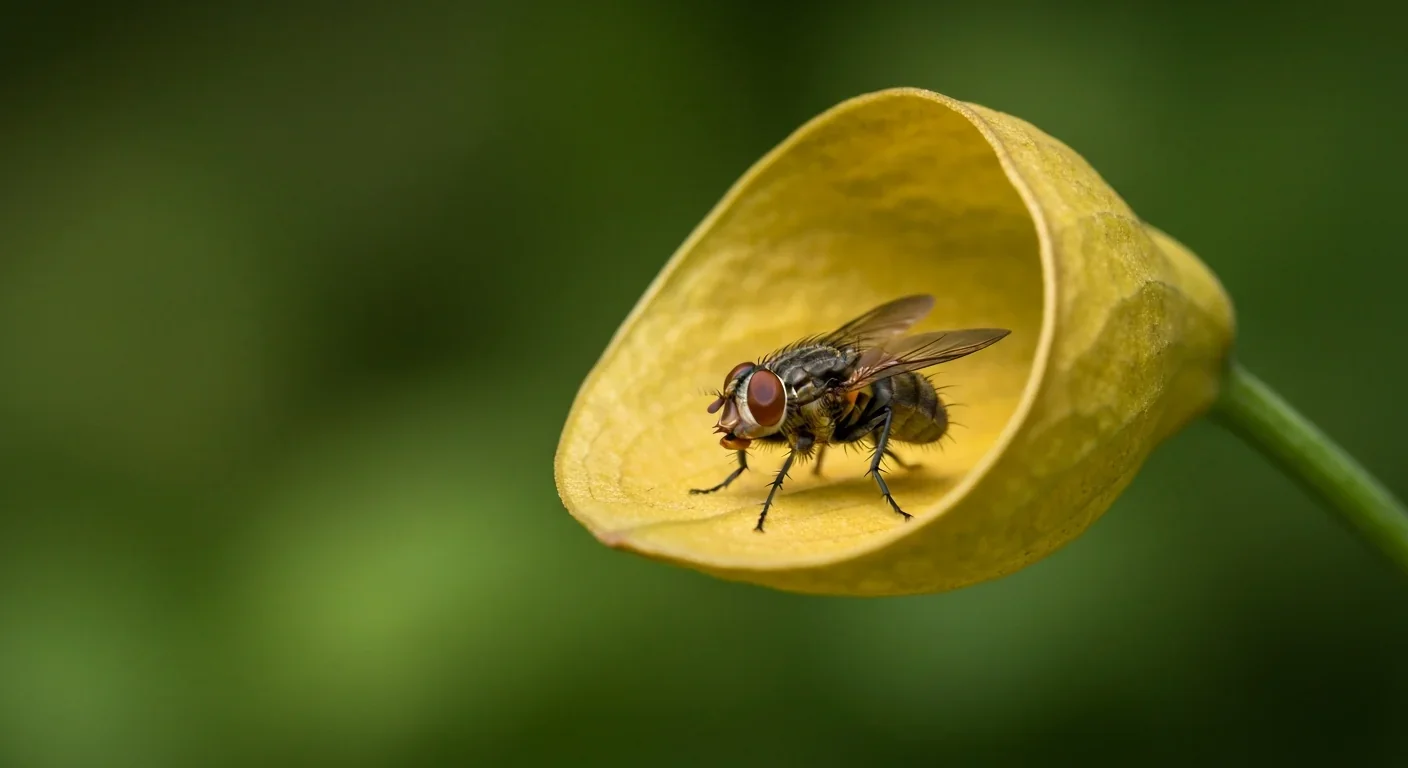
For the insects, the warm spadix is more than a scent beacon. It's a heated shelter. In sub-freezing conditions, a warm surface where you can rest and feed is a survival resource. Flies and beetles that enter the spathe get access to warmth, pollen, and nectar, and in exchange they carry pollen between plants. The plant strategically ramps up heat production when its female flowers are mature, maximizing pollination success during the critical window.

Heat production in skunk cabbage isn't random or passive. The plant increases thermal output precisely when its female flowers are receptive, timing its energy expenditure to maximize reproductive success.
Skunk cabbage isn't alone in this strategy. Roughly 90 thermogenic species have been identified worldwide, spanning multiple plant families, which tells us that heat generation has evolved independently several times through convergent evolution.
The sacred lotus (Nelumbo nucifera) is perhaps the most striking example outside the arum family. Its flowers maintain temperatures between 30 and 35°C regardless of whether the surrounding air is 10°C or 45°C. The lotus belongs to the order Proteales, entirely unrelated to the Araceae family that includes skunk cabbage. This phylogenetic distance confirms that thermogenesis arose independently in multiple lineages under separate evolutionary pressures.
The dead horse arum lily (Helicodiceros muscivorus) of the Mediterranean uses heat to amplify its carrion-like smell, attracting blowflies that become temporarily trapped inside the spathe while pollinating. Philodendrons in tropical forests use AOX-driven thermogenesis to maintain their spadix temperatures, with studies showing AOX protein levels increase five-fold at the onset of heat production.
Even ancient cycads, which predate flowering plants by hundreds of millions of years, are thermogenic. A Harvard University study demonstrated that cycad cones use infrared radiation to attract beetle pollinators, and lab experiments confirmed that beetles respond to heat alone, without needing chemical or visual cues. This suggests that using heat as a pollination signal may be one of the oldest communication strategies in the plant kingdom, predating the evolution of colorful flowers entirely.
"Thermogenesis should be energetically costly for an organism, right? You're just burning energy; you're burning carbohydrates that you made."
- Shayla Salzman, University of Georgia
The study of thermogenic plants is opening doors researchers didn't know existed. Understanding how plants regulate temperature at the cellular level could transform agriculture, particularly in developing cold-tolerant crops. If scientists can identify the genetic switches that amplify AOX activity, they might engineer frost-resistant varieties of important food plants that can protect their own reproductive structures from late freezes.
Biomimetic engineers are paying attention too. The energy efficiency of biological heat generation, powered by simple carbohydrate metabolism, offers inspiration for sustainable thermal management systems. The feedback regulation of AOX could inform the design of self-adjusting heating technologies that respond dynamically to environmental conditions.
Climate change adds urgency to this research. Evidence suggests that global warming is disrupting thermogenesis-driven pollination mutualisms. As temperatures shift, the finely calibrated timing between thermogenic flowering and pollinator activity may fall out of sync, threatening reproductive success for species that have relied on this strategy for millions of years.
Perhaps the most profound implication is philosophical. Thermogenic plants challenge the deeply held assumption that plants are passive, unresponsive organisms. A skunk cabbage regulating its internal temperature with mammalian precision, burning fuel at the metabolic rate of a shrew, and timing its heat output to maximize reproductive success suggests something closer to what we might call biological intelligence. Not consciousness, certainly, but a level of metabolic sophistication and environmental responsiveness that commands attention and respect.
The next time you walk through a late-winter wetland and spot a circle of melted snow around a strange, hooded flower, take a moment. You're witnessing one of nature's most underrated marvels: a plant that decided the cold simply wasn't going to stop it.

Project Orion was a real 1960s program to reach other stars by detonating 800 nuclear bombs behind a spacecraft. The physics worked and the engineering was feasible, but the 1963 nuclear test ban treaty killed it. It remains the most credible interstellar spacecraft ever designed.

The locus coeruleus, a tiny brainstem structure, degenerates decades before Alzheimer's symptoms appear. Its loss cripples the brain's inflammation control, waste clearance, and sleep regulation. New imaging tools and noradrenergic therapies offer hope for early detection and prevention.

Research shows the sharing economy often increases total resource consumption through the Jevons paradox and rebound effects. Ride-sharing adds billions of vehicle miles, co-working spaces use more energy per worker, and diffused responsibility erodes conservation behavior. Breaking the paradox requires congestion pricing, accountability design, and matching sharing models to appropriate resource types.

Psychological reactance theory explains why banning or restricting things makes people want them more. From Prohibition to the Streisand effect to scarcity marketing, research shows that threatening people's freedom reliably backfires, and autonomy-supportive communication is far more effective.
A carnivorous pitcher plant in Borneo evolved to house bats instead of trapping insects, gaining up to 95% of its nitrogen from bat guano. The plant even built an ultrasonic reflector to help bats find it, revealing that carnivory in plants is a flexible spectrum.

The quantified self movement began as a hacker-ethos pursuit of personal insight, but corporate wearables now funnel biometric data to employers, insurers, and data brokers. With 81% of Americans wrongly believing health apps are HIPAA-protected, a regulatory void enables health data to be sold for pennies while generating anxiety instead of empowerment.

CXL memory pooling lets servers dynamically share DRAM over a cache-coherent interconnect, eliminating the 40% stranded memory waste in data centers. With commercial hardware now shipping and Azure deploying CXL cloud instances, this technology promises to cut memory costs by 50% while enabling composable infrastructure.

Loading featured articles...